Fairground and Market Stalls
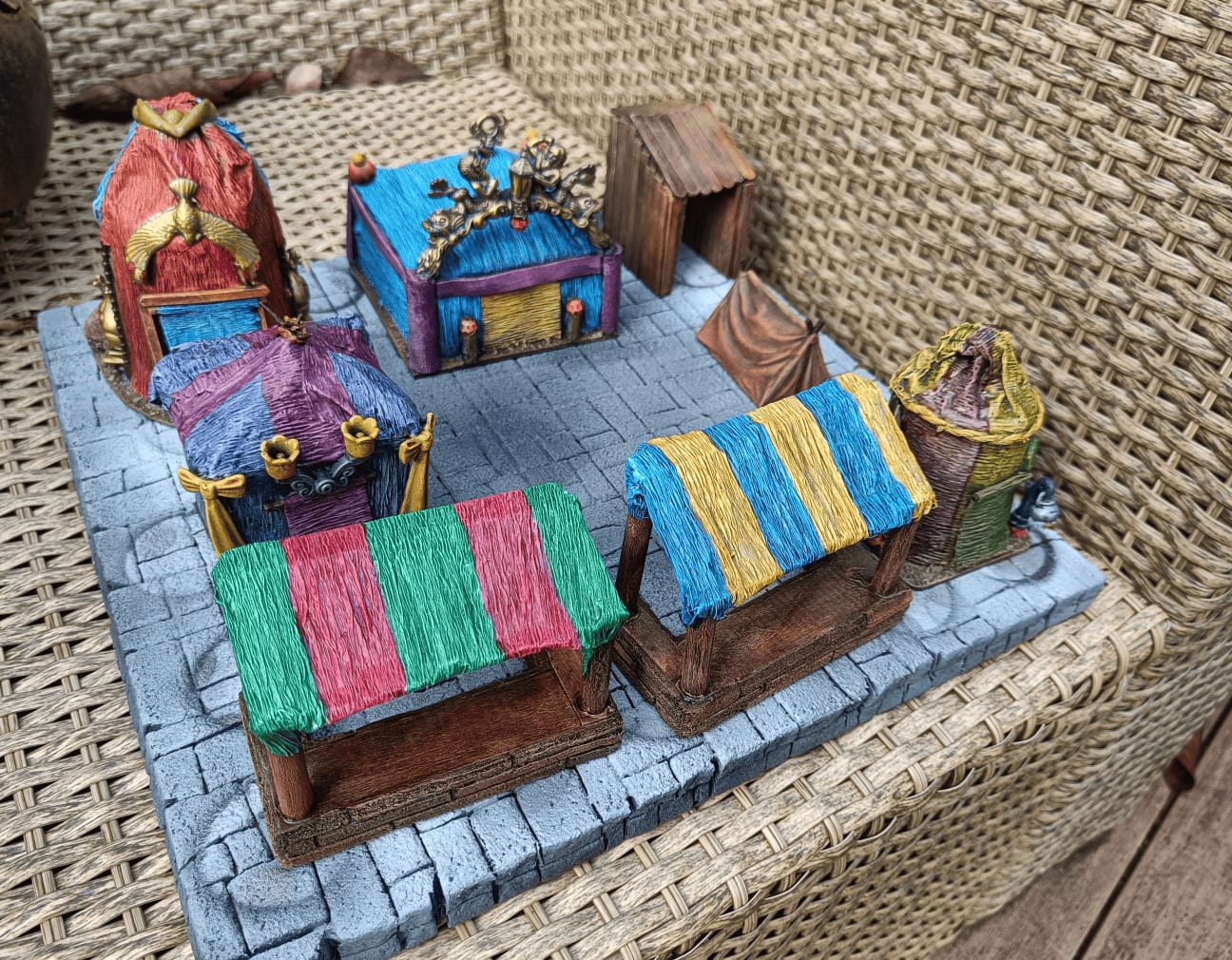
My players were about to get teleported to the First World for a big celebration, and I realized I had no scenery for that kind of event. I needed tents, market stalls, and colorful festive structures. The nice thing about this project is that it’s versatile: these pieces can work for a village market day, a wedding celebration, a fairground, or even a military camp.
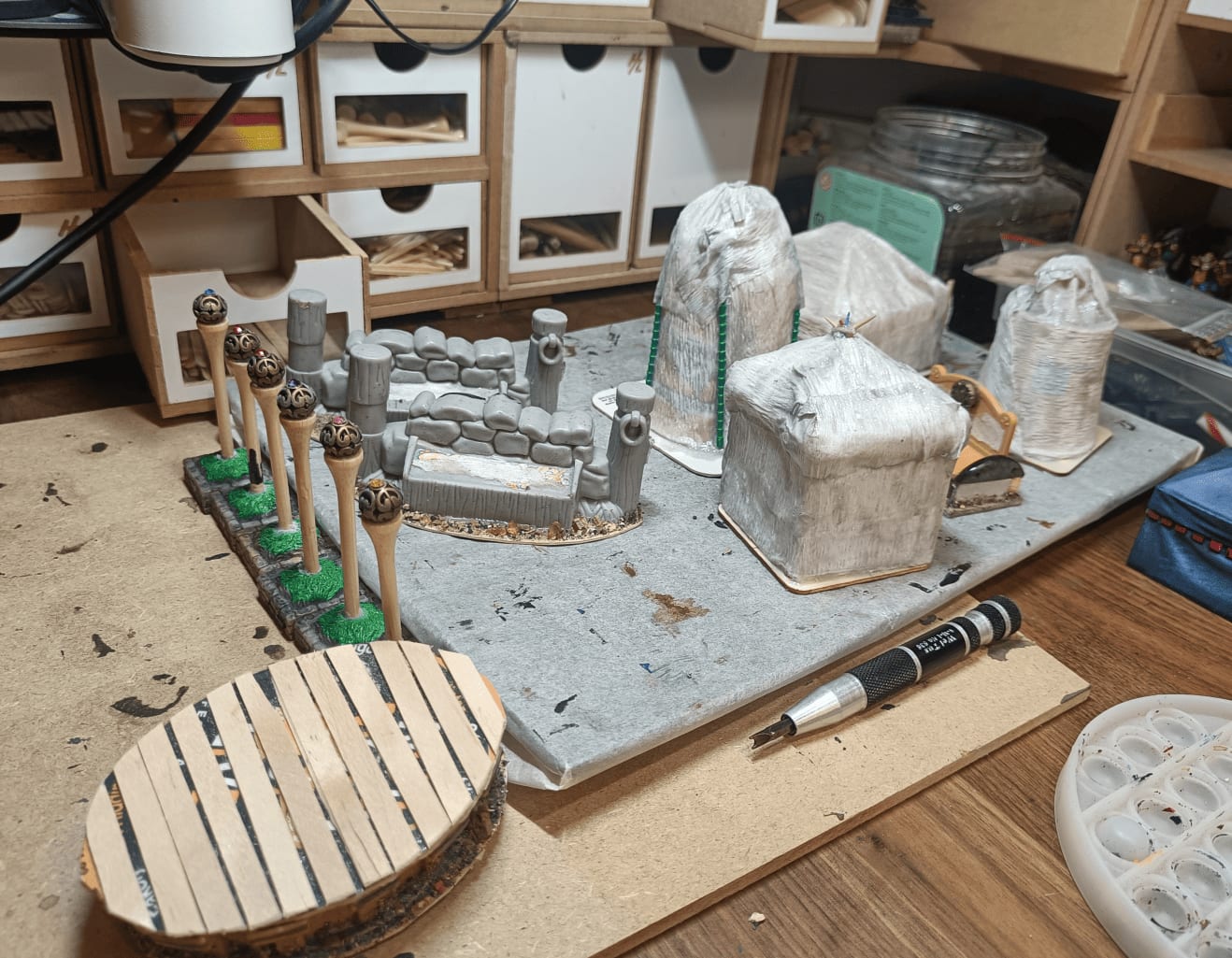
Here are the elements before I fully painted them. The stone walls you can see come directly from a toy. The scale isn’t perfect for miniature gaming, but I figured they’d work as a good base and I could add details on top to give them more character.
On the left, I wanted to make lampposts or poles where you could imagine lanterns hanging. The base itself I found at a hobby shop. I think it was originally part of Christmas decorations for planting little trees, but I just kept the bases. The poles are golf tees, and on top I glued small beads I’d picked up for a few euros at a variety store.
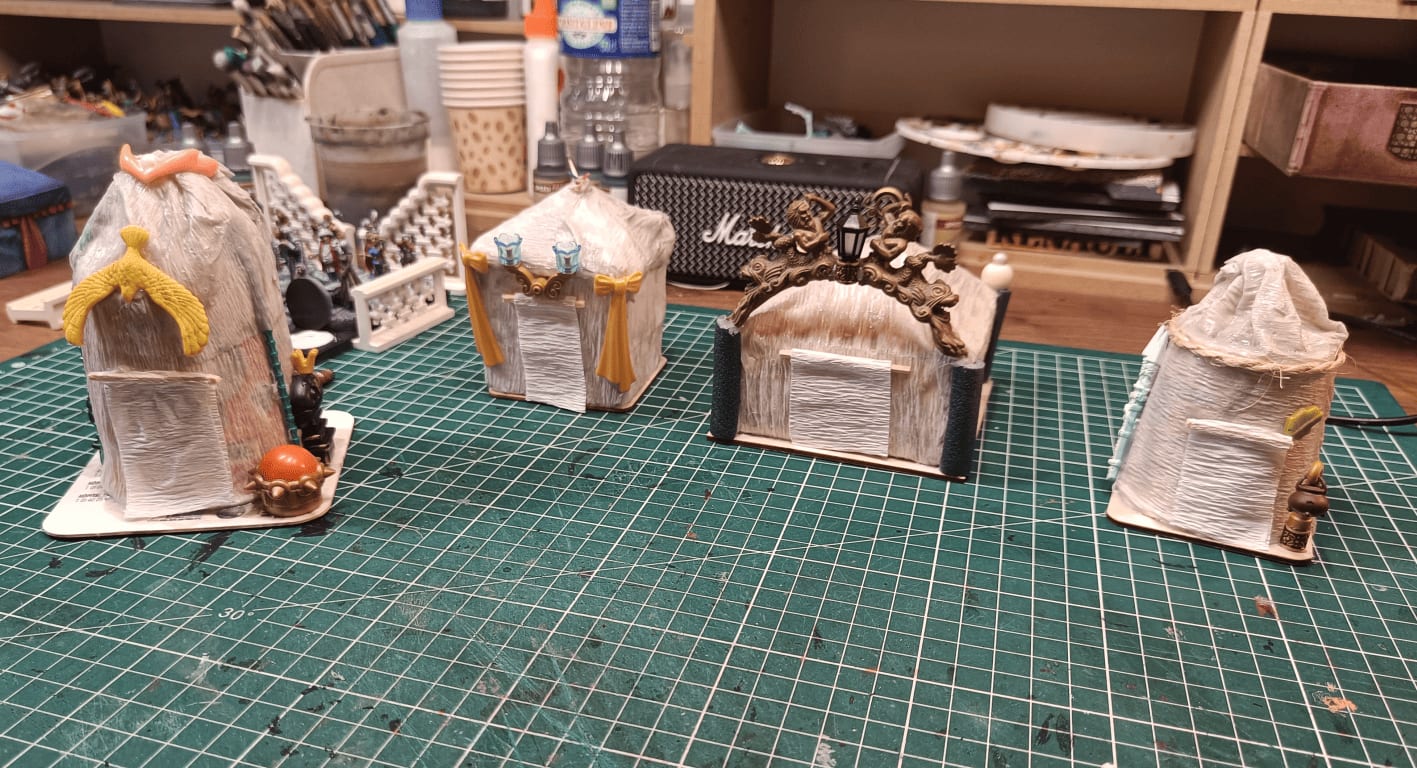
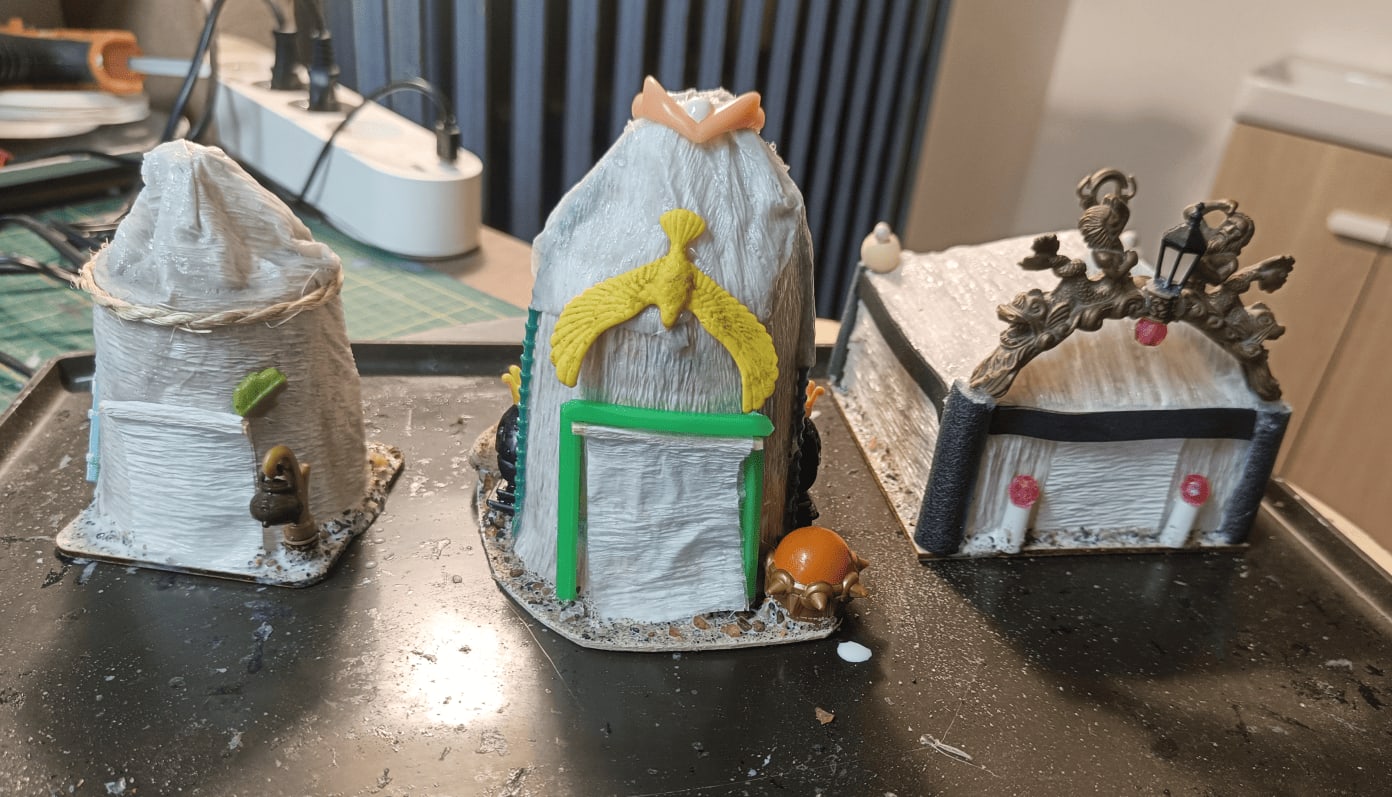
Here you can see I tried making tents. I had no idea how to make tents, but my main approach was to find a shape and then add fabric over it. I tried using crepe paper because it’s flexible and can be stiffened with a water and glue mix. The round ones are made of cardboard cups turned upside down. I think I added a foam ball on top to extend the height a bit, then put the paper over it. That’s not my favorite because it doesn’t really look like a tent shape.
For the square ones , I think I cut foam squares and stacked them on top of each other. Then I tried to arrange foam squares on top to form roughly a triangle, and again I added crepe paper over it.
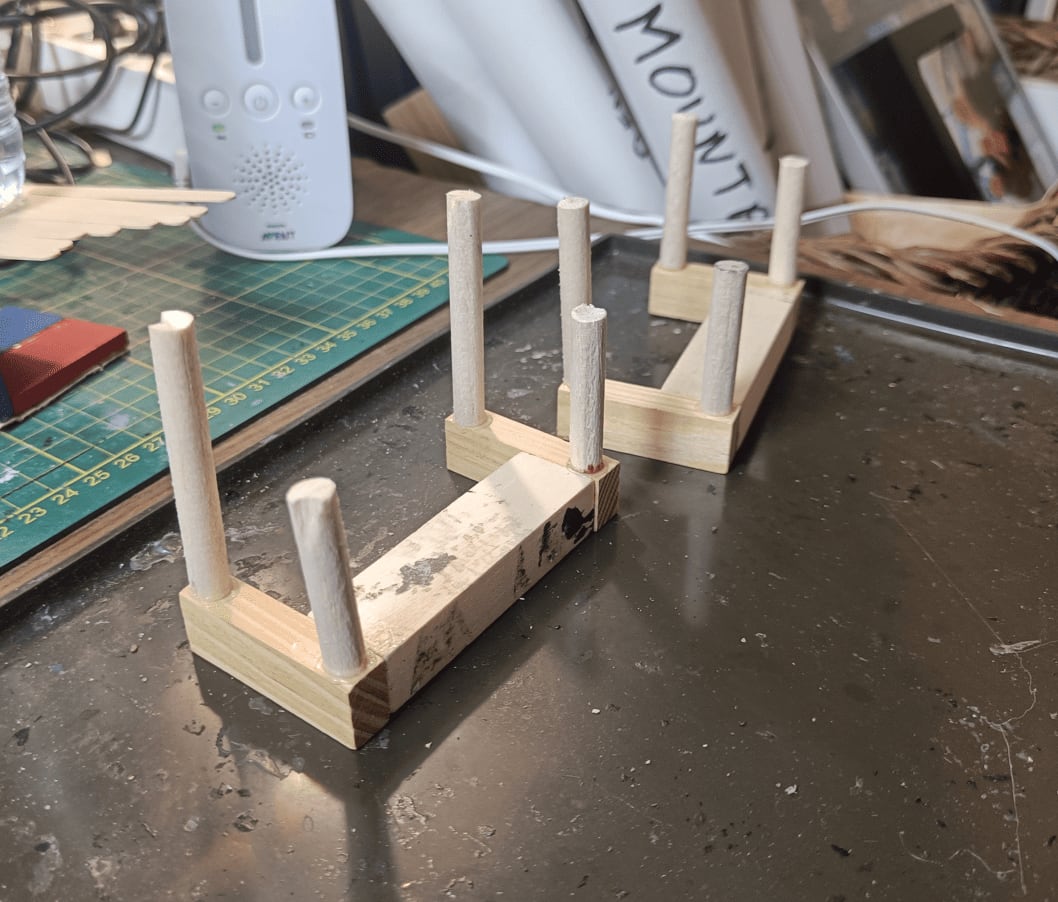
These are the stalls or market stands. They’re made from Kapla blocks glued together, and the vertical posts are pieces of balsa wood attached with hot glue.
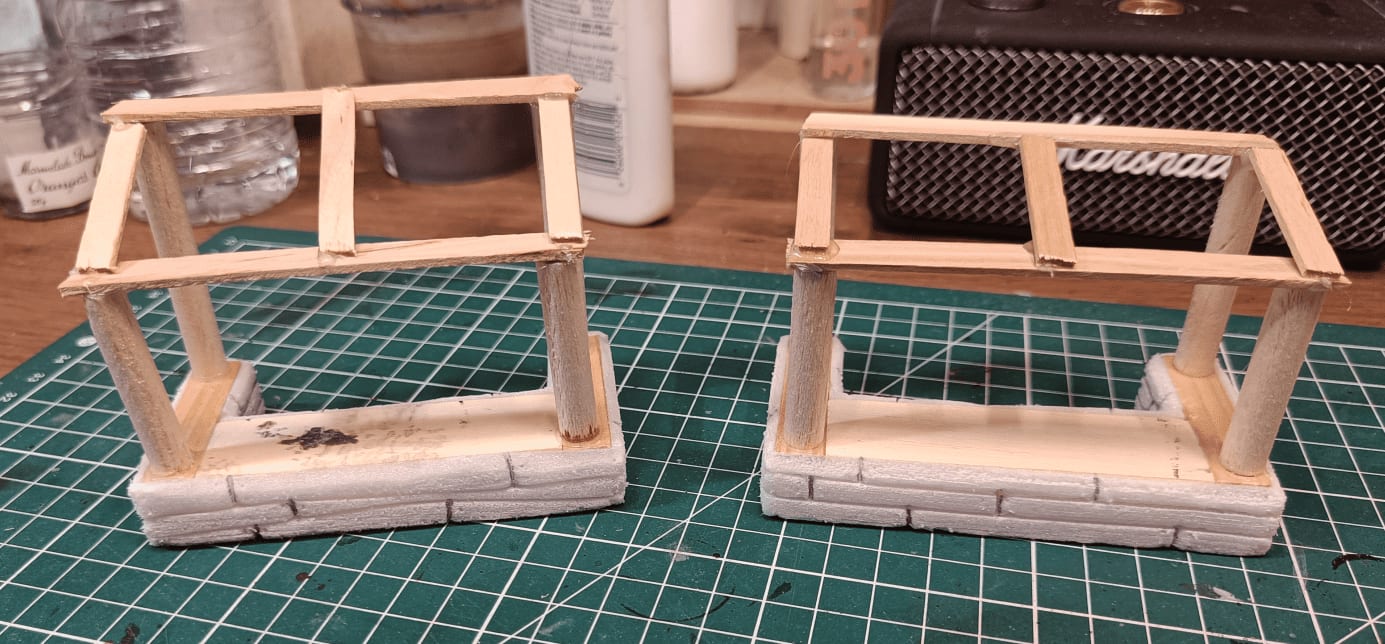
Here’s how I made the roofs: popsicle sticks glued on top. A horizontal strip along the top edge, another horizontal strip along the bottom edge, and then vertical strips to connect them together. After that, I used the same technique of adding crepe paper over it and soaking it with a water and glue mix so it stiffens in place.
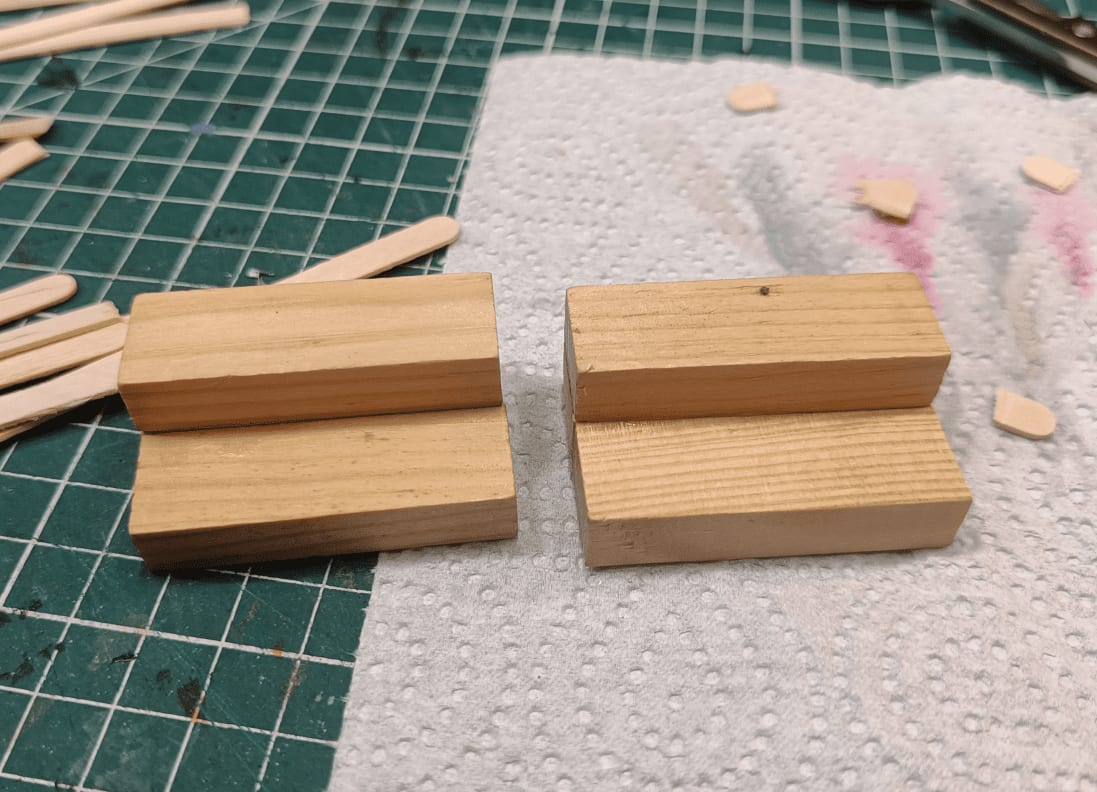
Here are more Kapla blocks glued together to form a little staircase. I figured stairs are always useful to have, so I made some while I was at it.
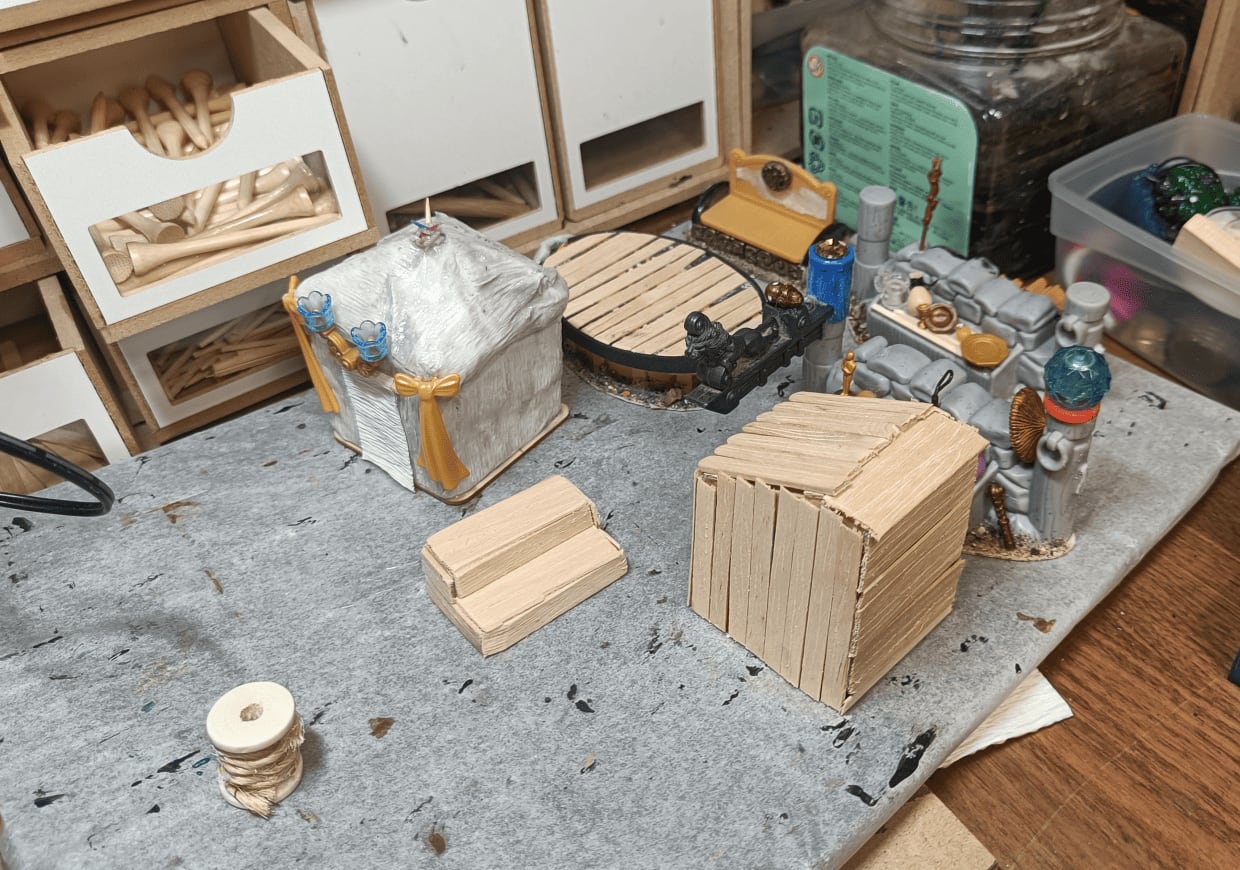
Lots of things in progress before I primed everything. You can see the little staircase, and there’s a little cabin I made with way too much work for what it’s worth. I had to glue tons of wood pieces together and carve the wood. In the end it’s not even very useful and it’s not one of my favorite pieces. Behind you can see the toy walls I mentioned earlier. I glued some bits and bobs I no longer need to give them a different look.
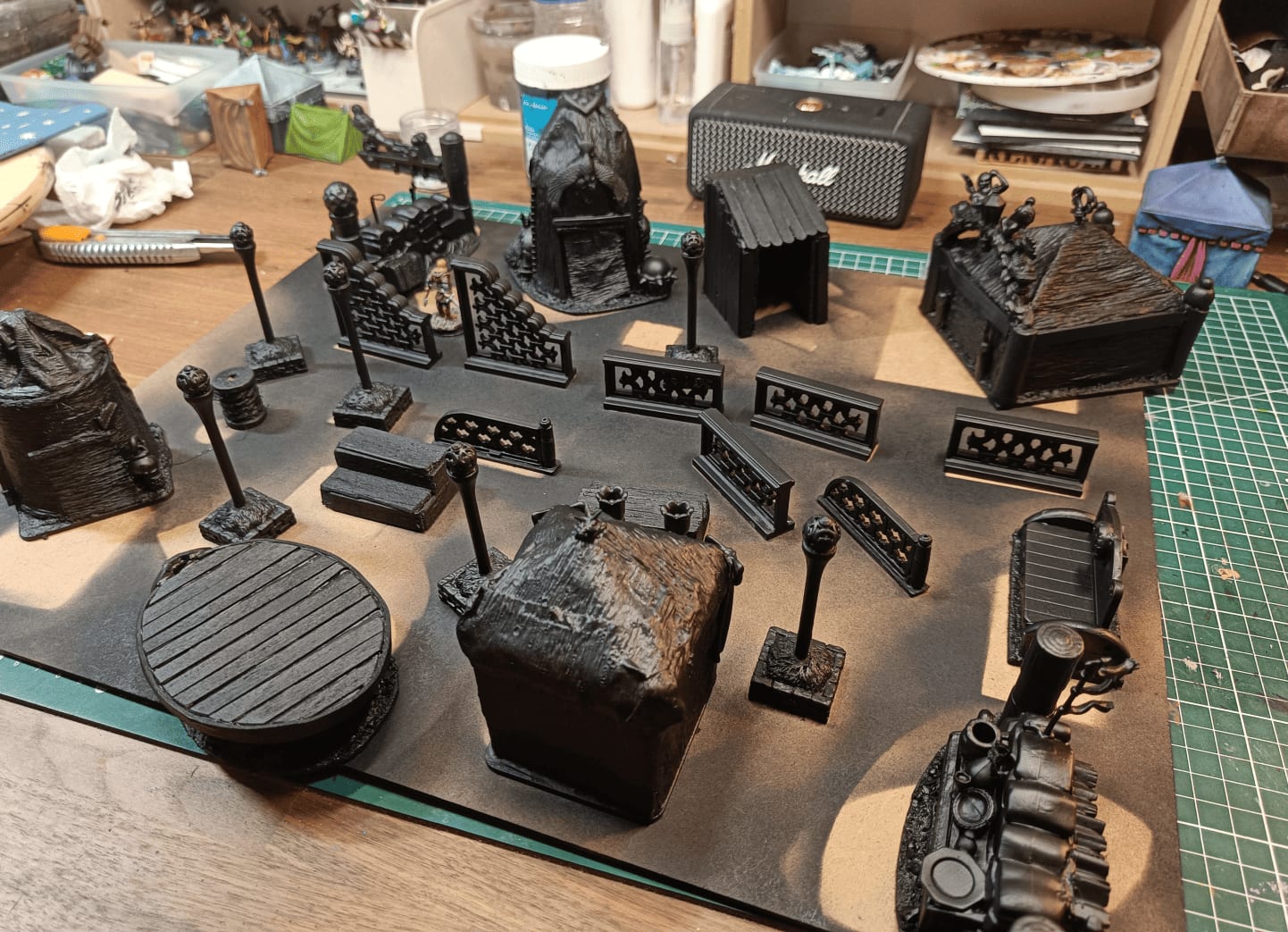
Everything once it’s primed in black. I think I went straight to black primer without using the Mod Podge I usually apply, because there was already so much texture and I was worried it wouldn’t go everywhere properly and might soften the effects. Y
You can see lots of little fences. They’re typical Playmobil fences that I repurposed.
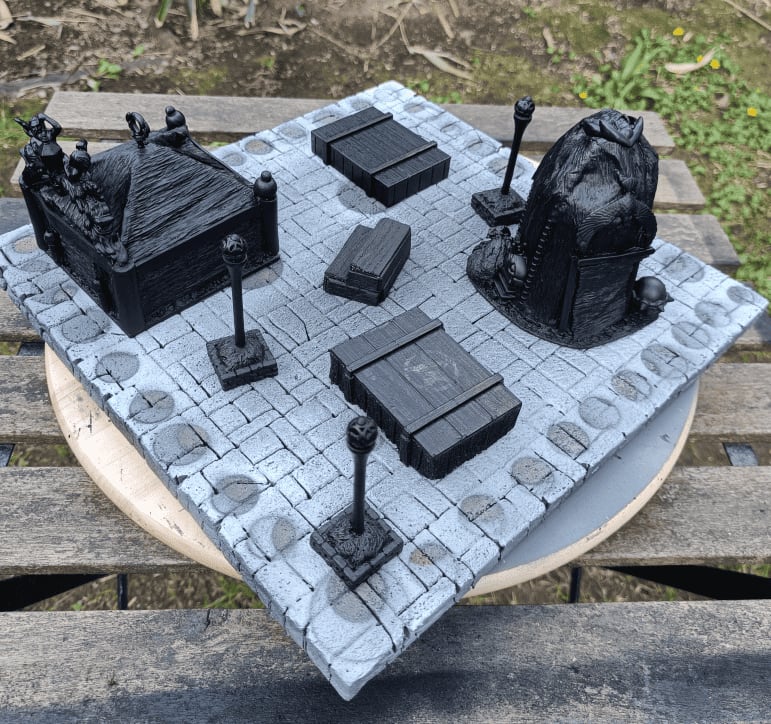
Me outside priming all of this. The first coat in black.
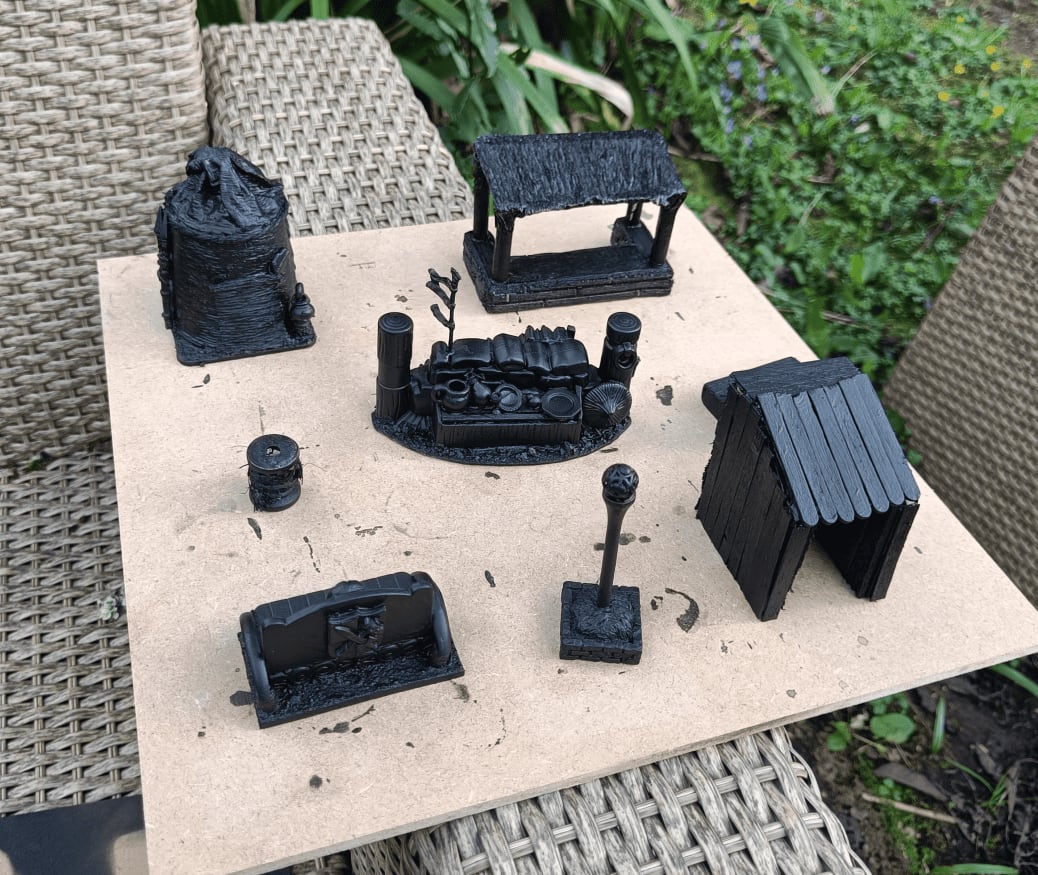
Another batch that’s been primed in black. Now I’m going to start applying multiple coats of different colors.
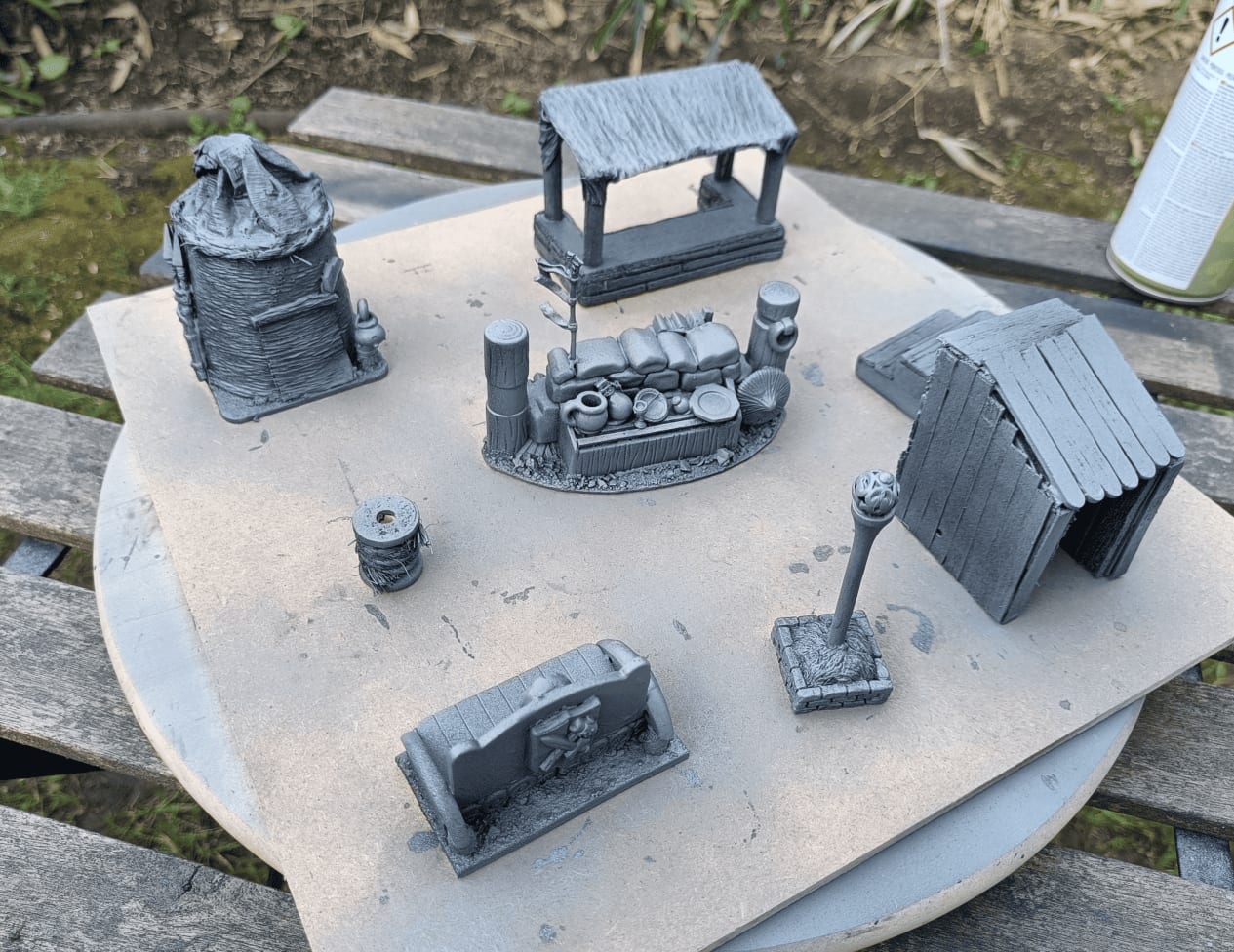
Same thing but I’ve applied a gray primer coat. With the black primer, I make sure to really get into every spot. The goal is for the interior crevices to stay black, so everything is uniformly black.
For the gray primer, I stand a bit further back and do a kind of dust cloud of gray paint that settles where it wants. I think you can already see the texture well thanks to that layer, and I find it easier to paint when everything isn’t uniformly black and you can see the relief.
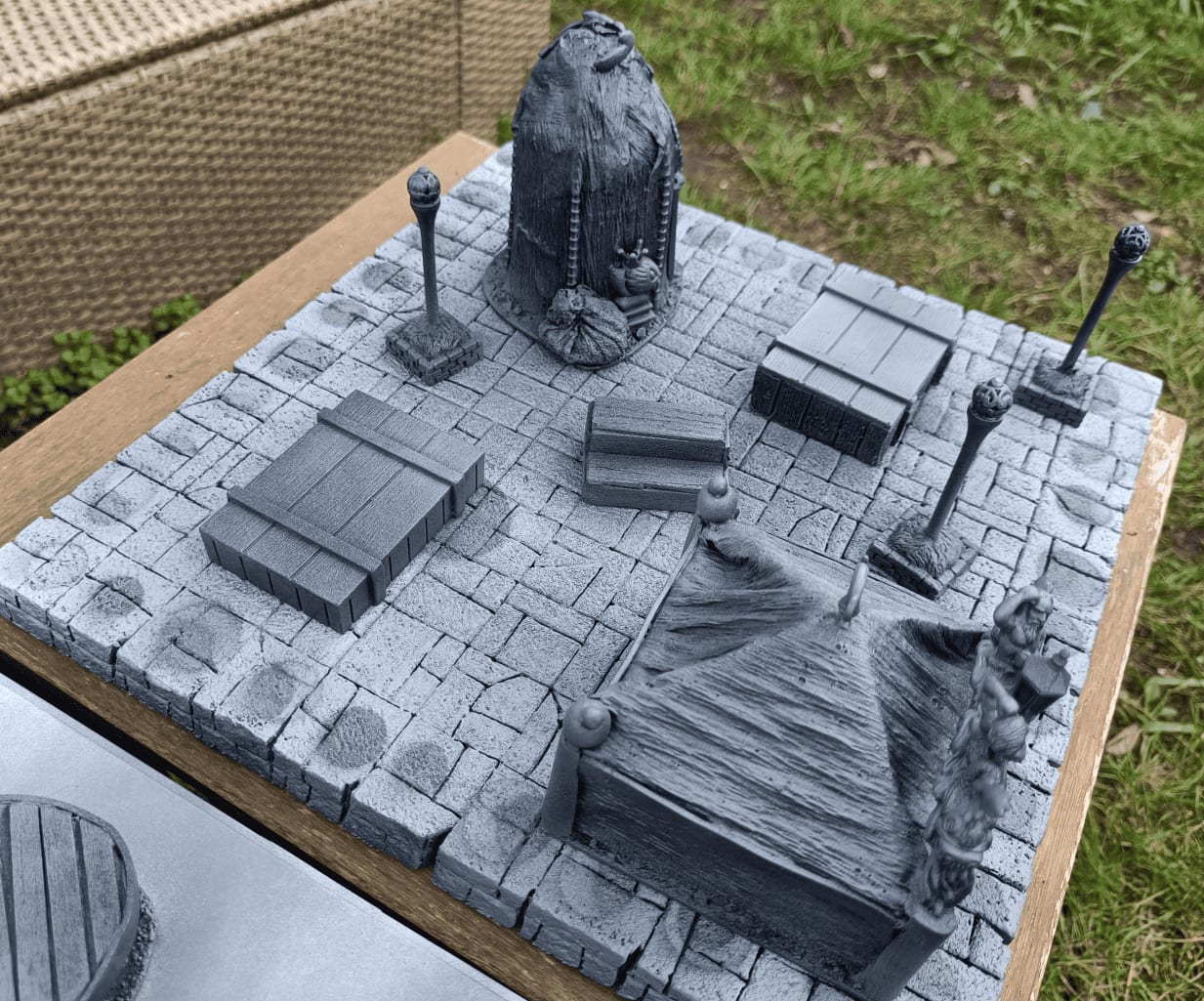
Same thing, I’ve applied the same gray paint mist coming straight from the aerosol can, but I stand a bit further back from all the elements.
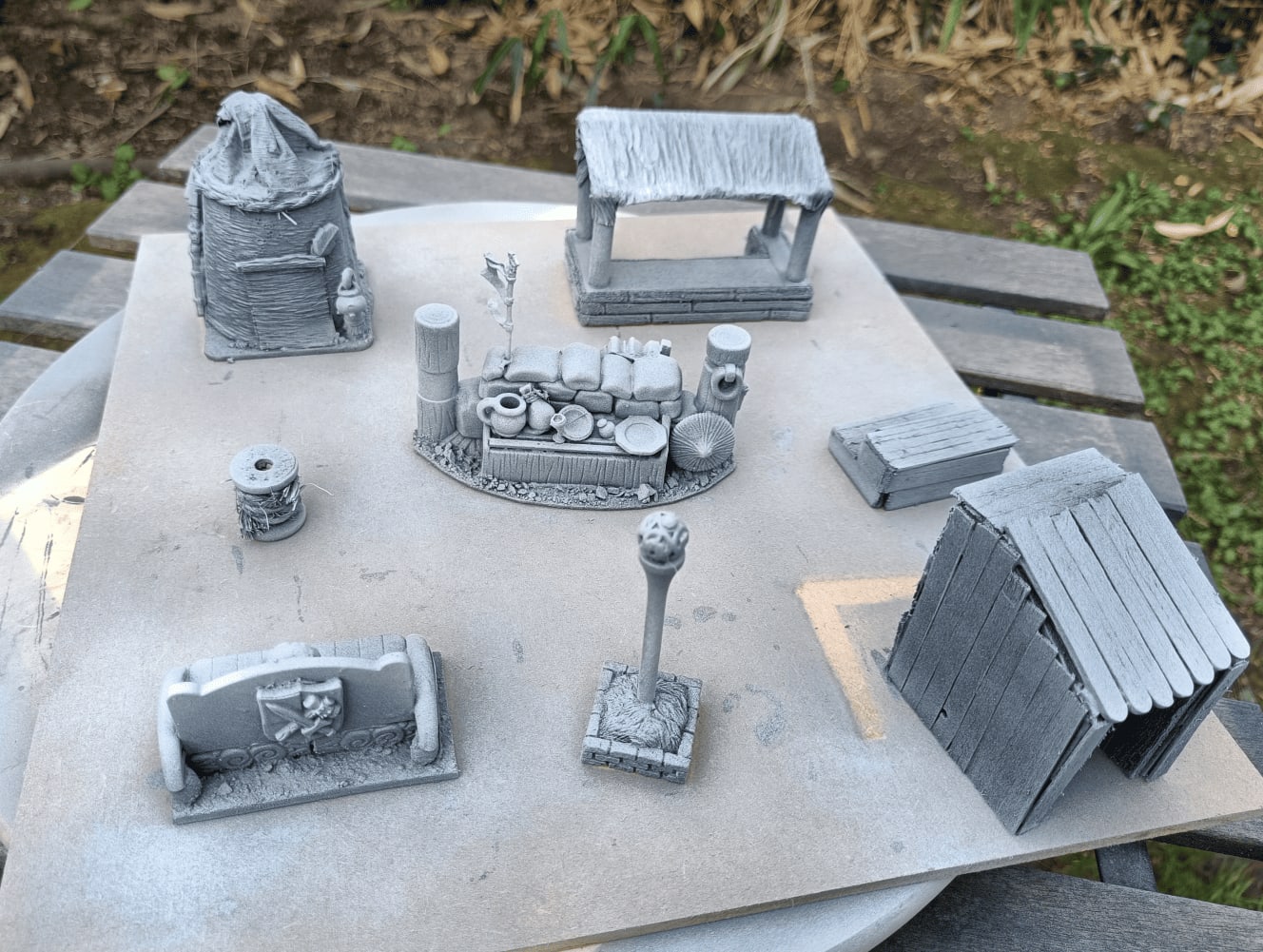
I tried doing what’s called zenithal priming, so I take the white paint can and I only spray from above. Only the top of the miniature or scenery gets white. The idea with this is that it draws the eye a bit more to the upper parts and the lower parts stay a bit darker.
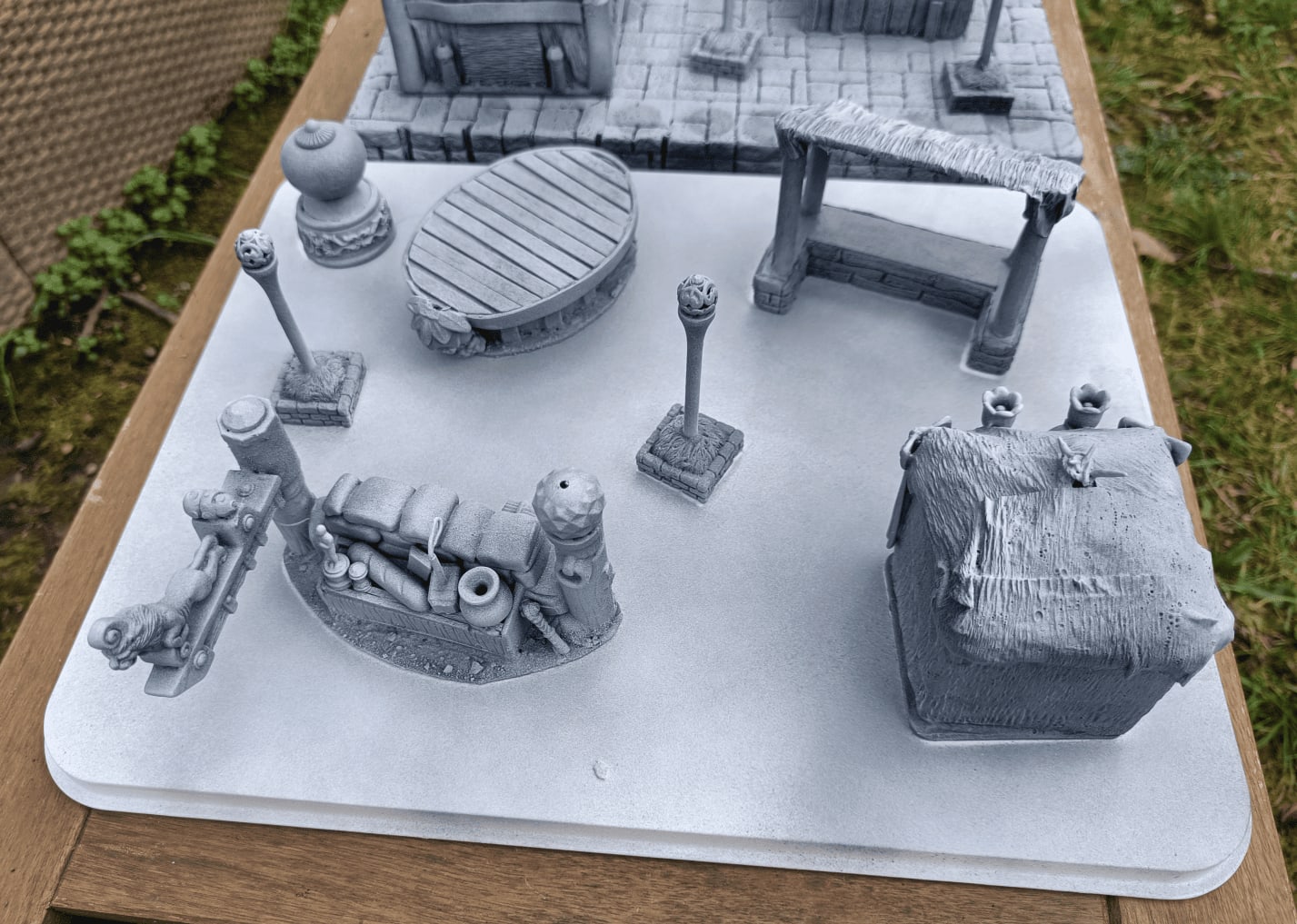
Same thing but applied to different scenery pieces.
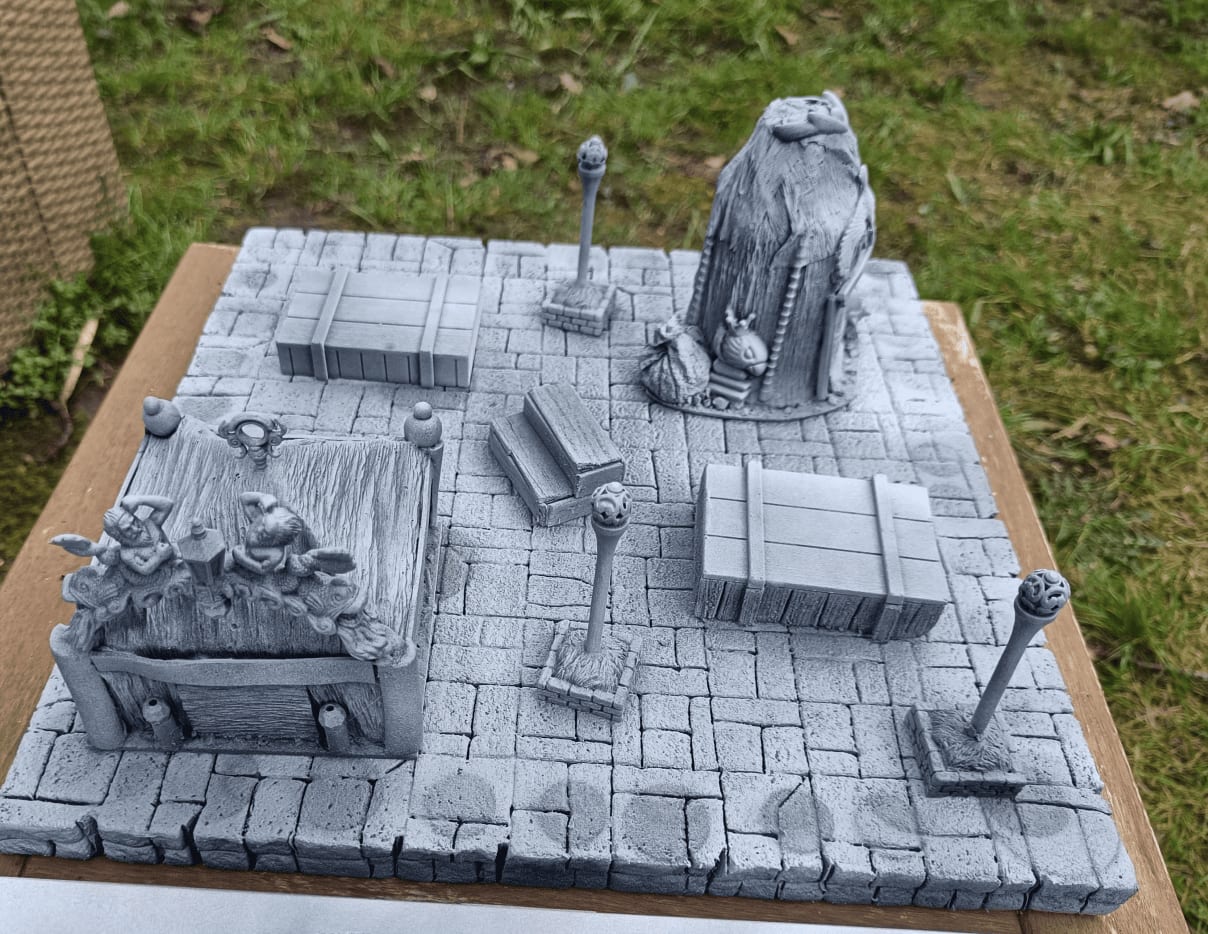
Same thing again applied to the last batch of elements. What you can see in this image is on the tent that’s completely on the right, there’s a kind of bag next to an eagle head. The eagle head comes from a plastic toy. The bag is a tea bag that I dried and placed here.
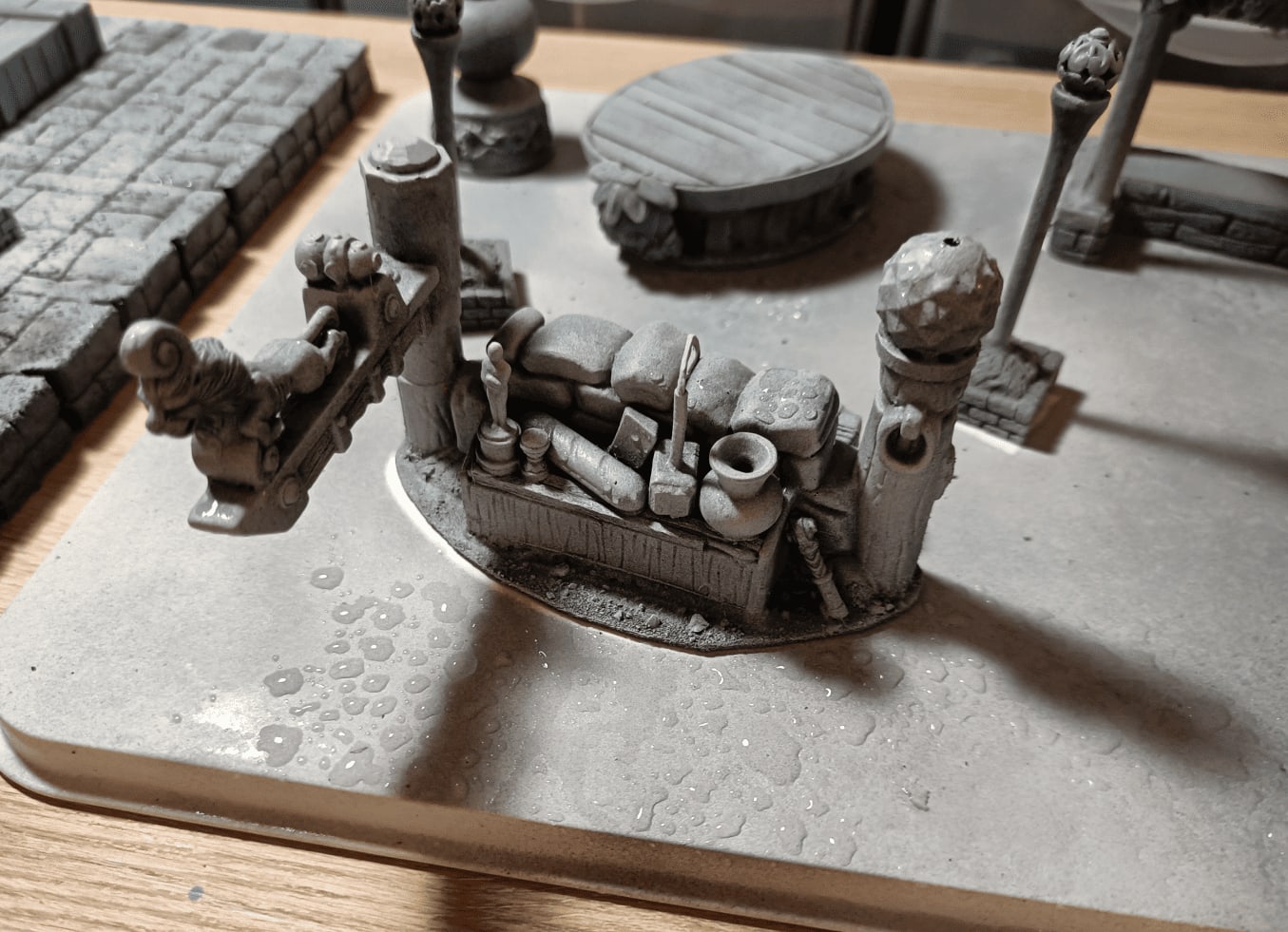
What happened here is that I properly primed all my stuff and left it outside to air out, except I forgot them there all night. The next morning when I came to get them, all the morning dew had settled on them. I was worried it might damage things a bit, but in the end it was fine. I let them dry and was able to paint over them without any issues.
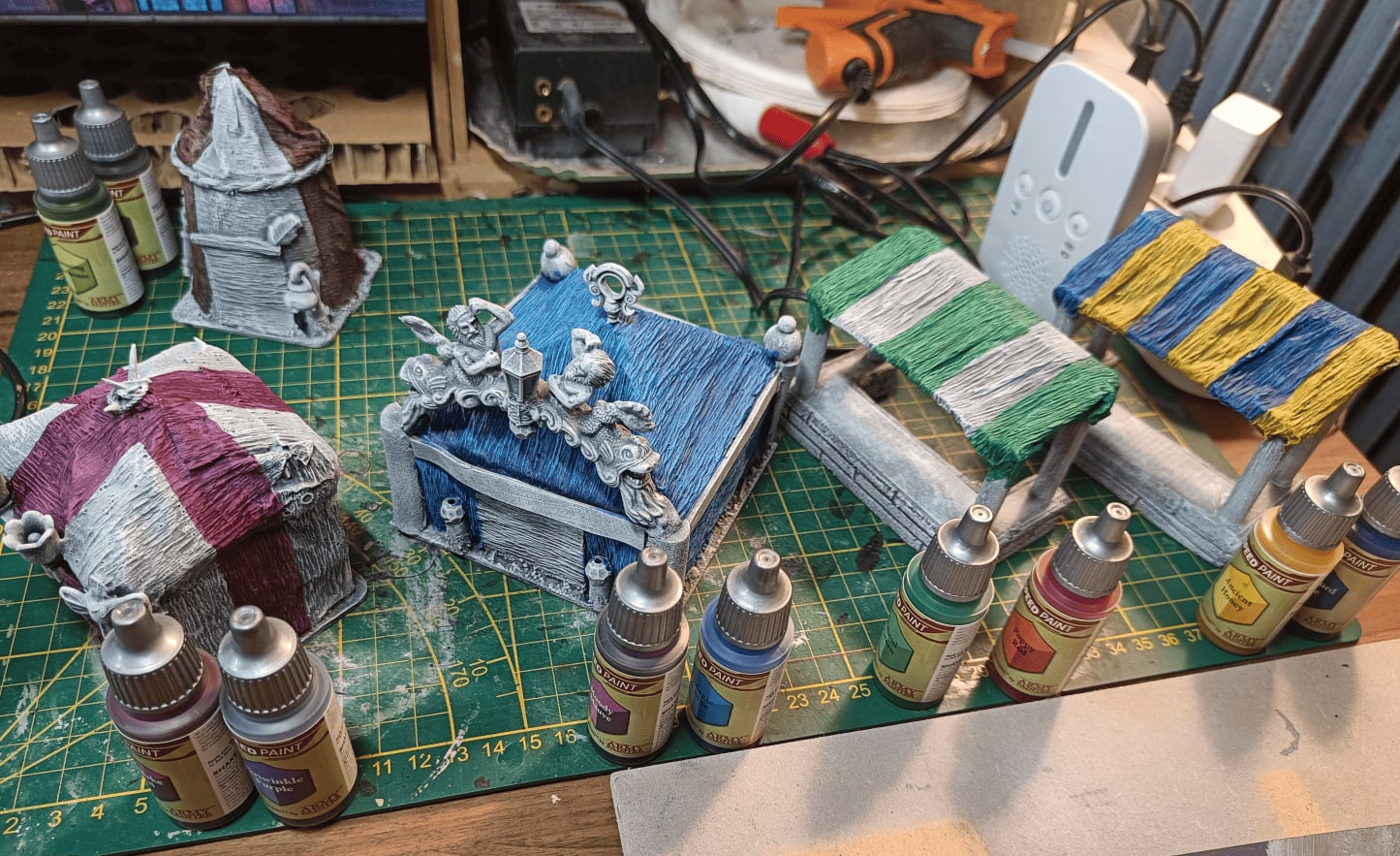
There’s potentially a phase I didn’t photograph, which is that I do another white drybrushing over all my elements, even after the primer. That lets me re-emphasize all the edges even more and makes the Speedpaints work much better.
I decided to paint these with Speedpaints, whereas usually I paint my scenery with drybrushing layers. I keep Speedpaints for actual miniature. Here I wanted to do everything with Speedpaints because I think they give a really good effect with different textures in different places, and especially because I have Speedpaints in very bright colors, so I figured that would work well. I tried to keep two colors that could work well together each time.
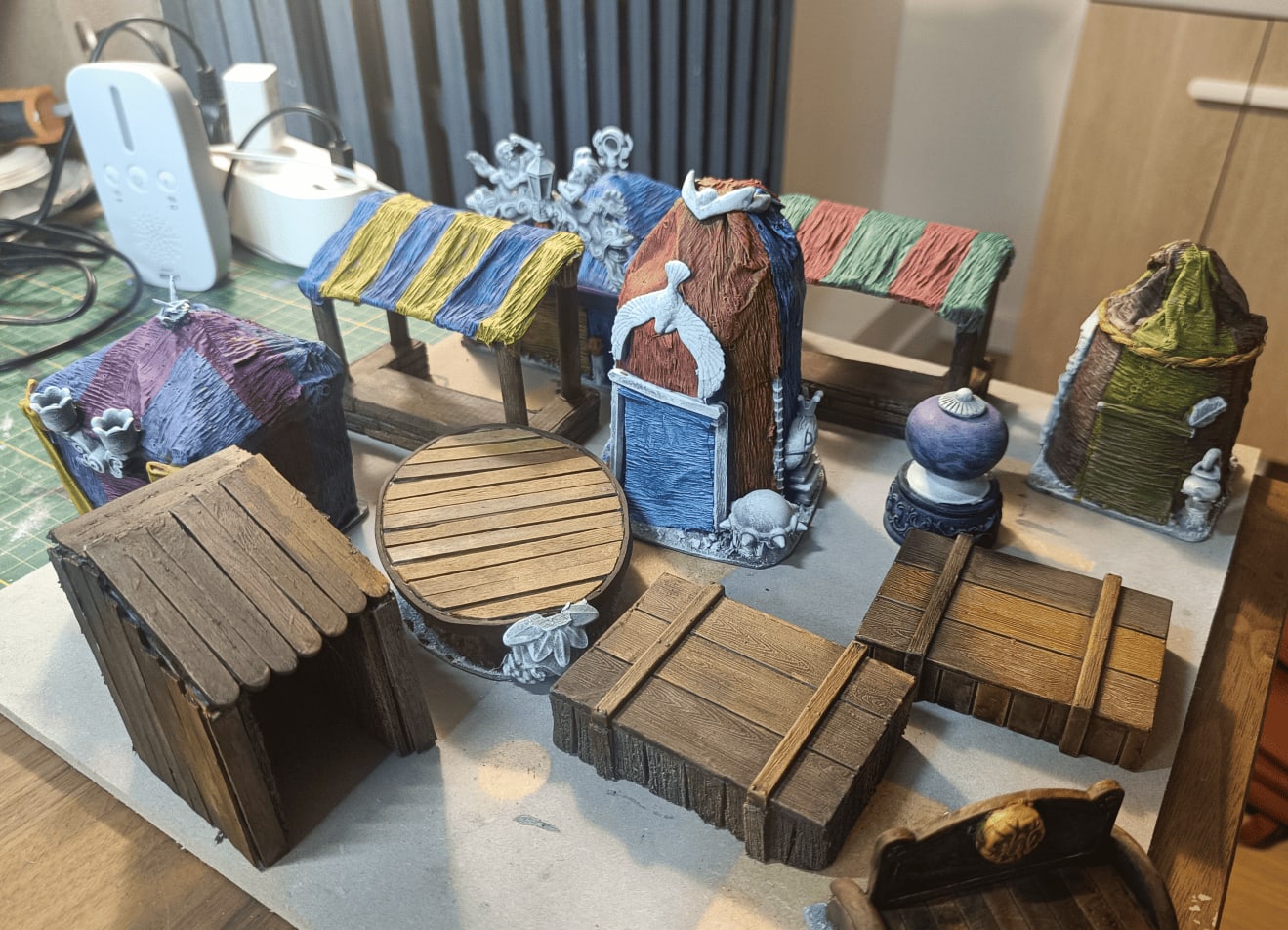
I like the stalls, the blue and yellow go really well together, same with the red and green.
However, the choices I made for the tents work less well. The ugly green with the purple works only moderately well. The orange and blue could have worked, but I think the shape of my structure isn’t great. And the violet and mauve are way too similar, plus I painted on the fabric without there really being any separation in texture, so it doesn’t render super well.
On the other hand, I’m happy with how the different wooden elements turned out. I also did those with Speedpaint. I used different types of brown paint and tried to change the colors a bit depending on the planks, and sometimes I mixed them together a little. I’m happy with the result.
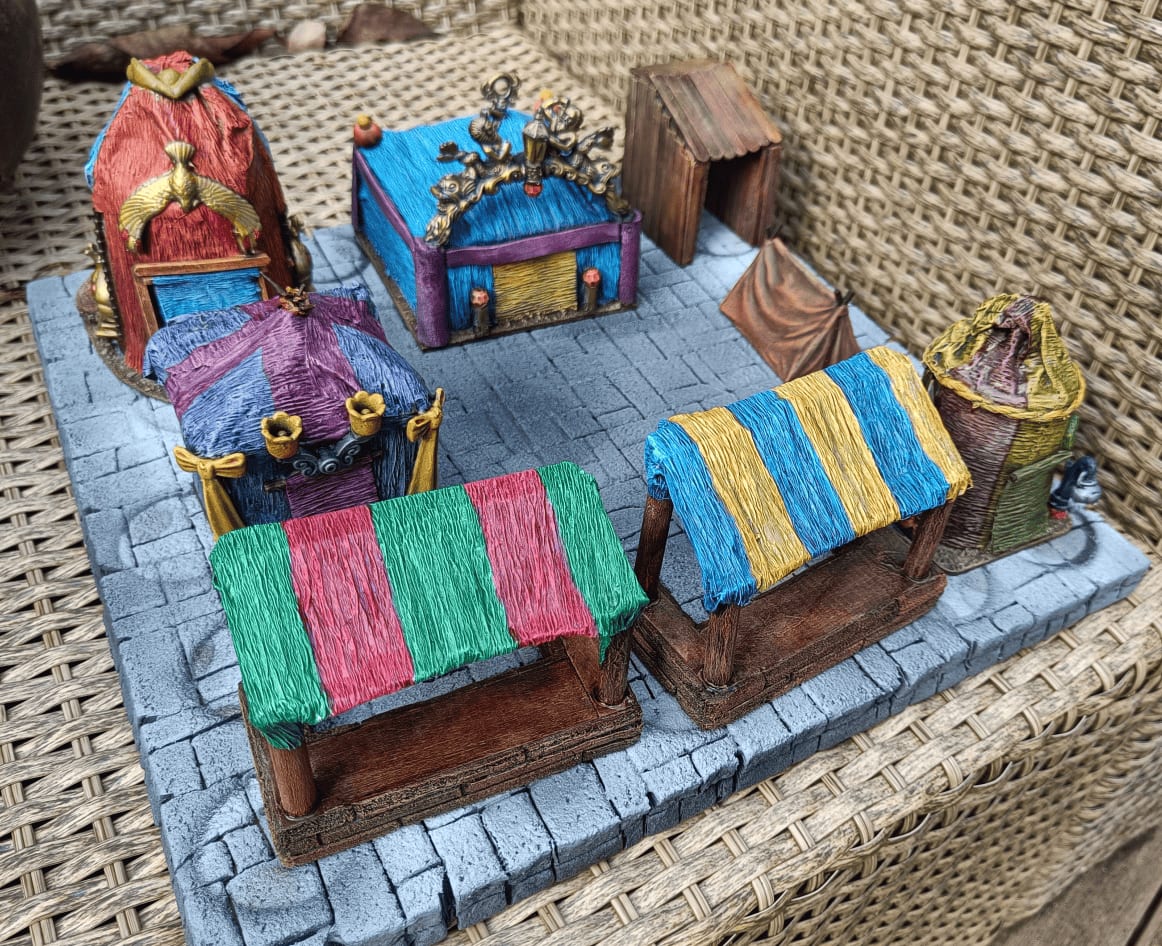
The more or less finished version. I completed everything and varnished it all. Actually, I realized it’s pretty good to use Speedpaint for painting the ground and the gravel with just one coat of something like Sand Golem or Runic Grey or Goddes Glow. It creates the darkening and lightening effects directly without needing to do any drybrushing.
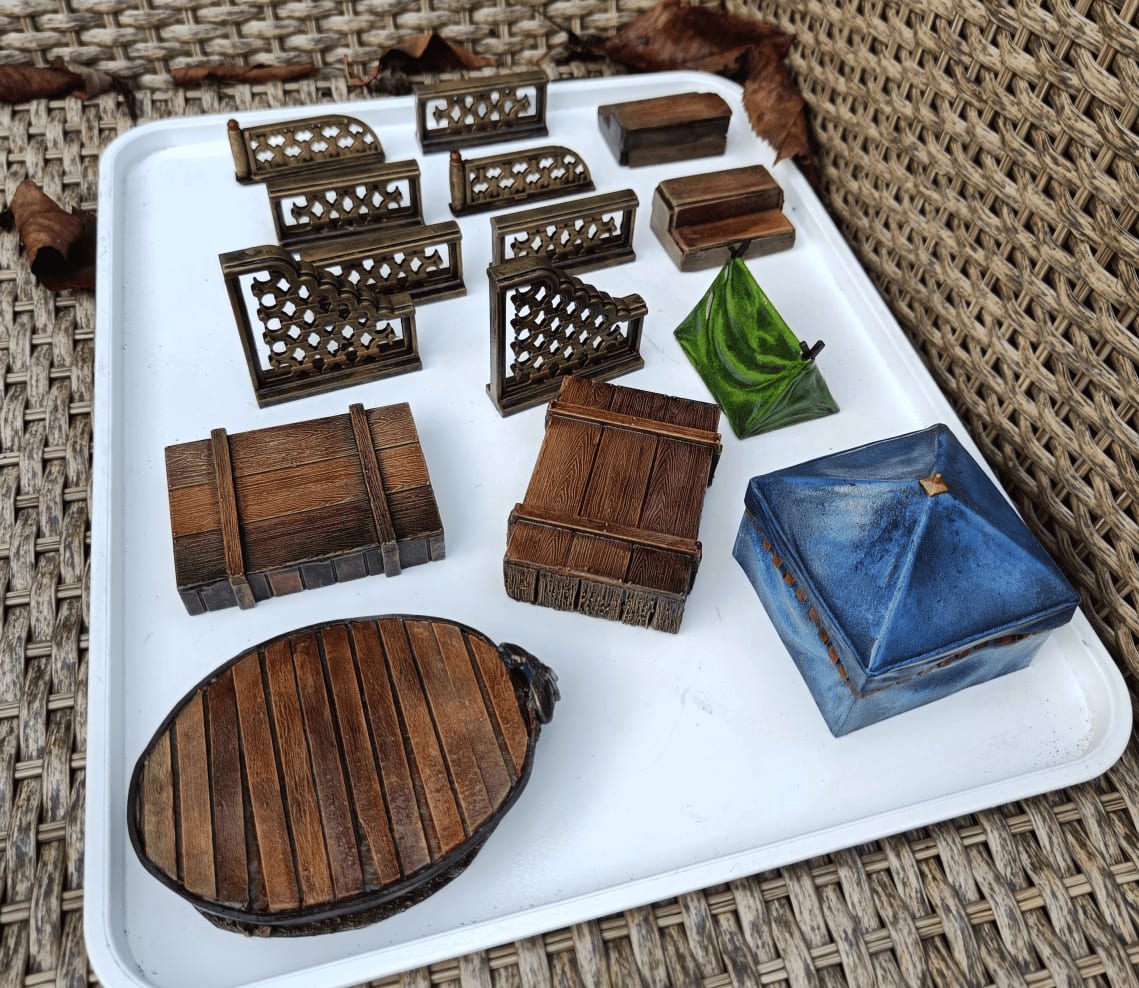
Another shot of what it looked like once varnished. It’s still a bit shiny here because I just applied the varnish, but it’ll tone down over time.
The little green tent I’m quite happy with because just with my basic drybrushing and a coat of Speedpaint over it, it looks good. I think it looks less good on the big tent because the blue color I used on the bottom isn’t pigmented enough, so it doesn’t render as well. Plus it’s big flat surfaces, so the Speedpaint doesn’t necessarily work as well in that spot.
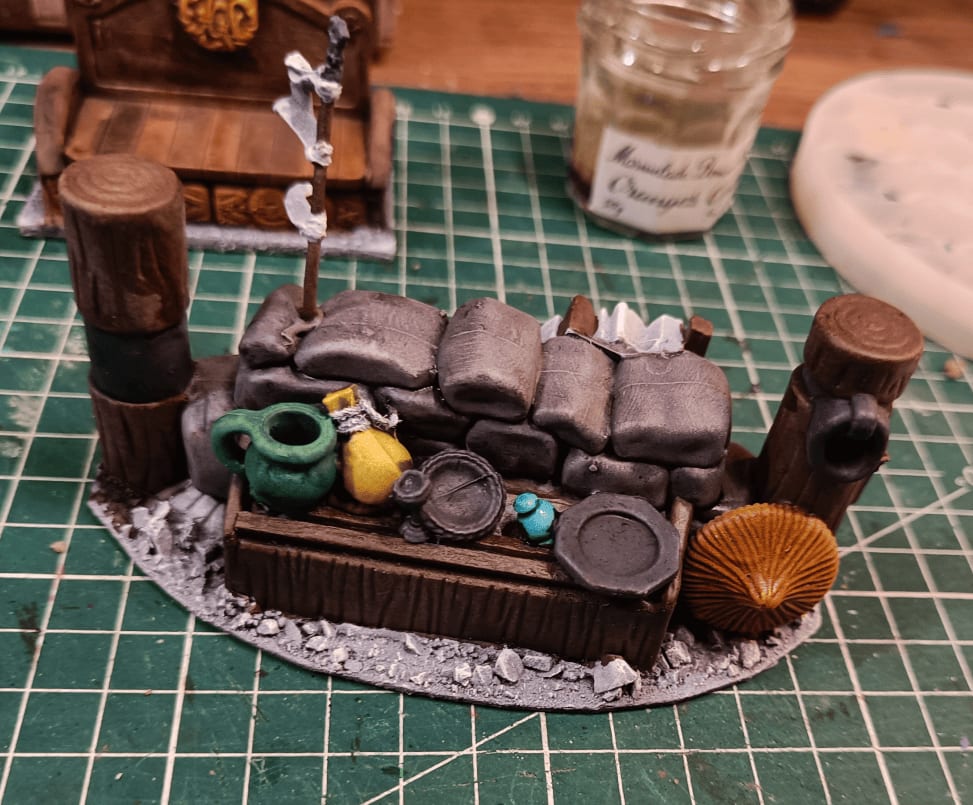
I’m starting to paint all the little details on my walls. I really glued tons of little odds and ends that come from different things and I colored them with lots of different colors.
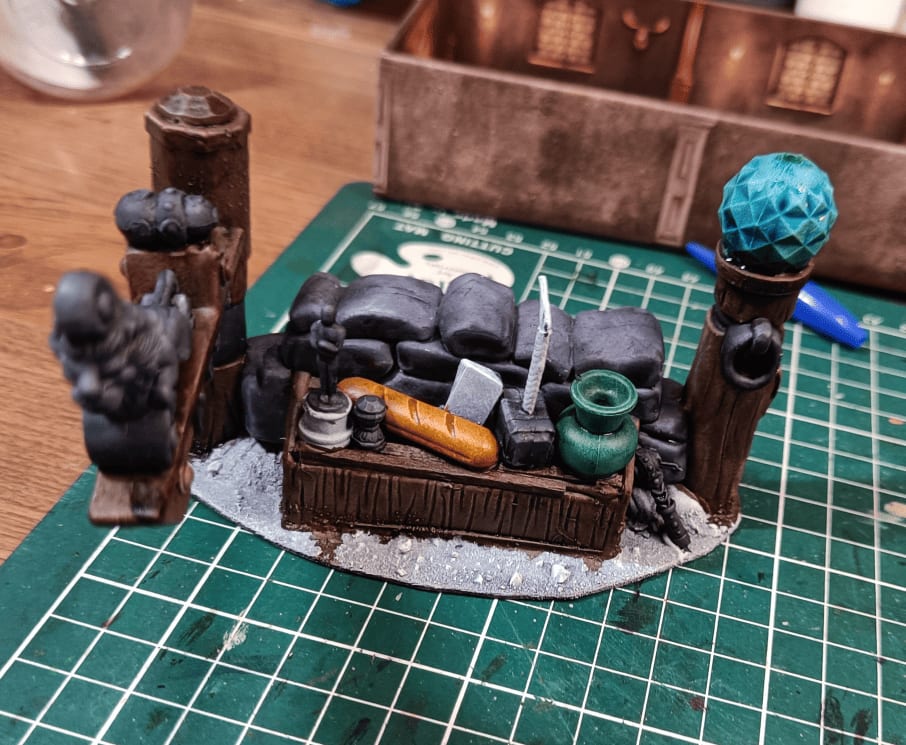
Same thing, there’s really everything. There’s a baguette, an Oscar statuette, Thor’s hammer, a deck of cards 🤷. I put the figurehead from a boat on the side to make it look a bit like the stall’s sign.
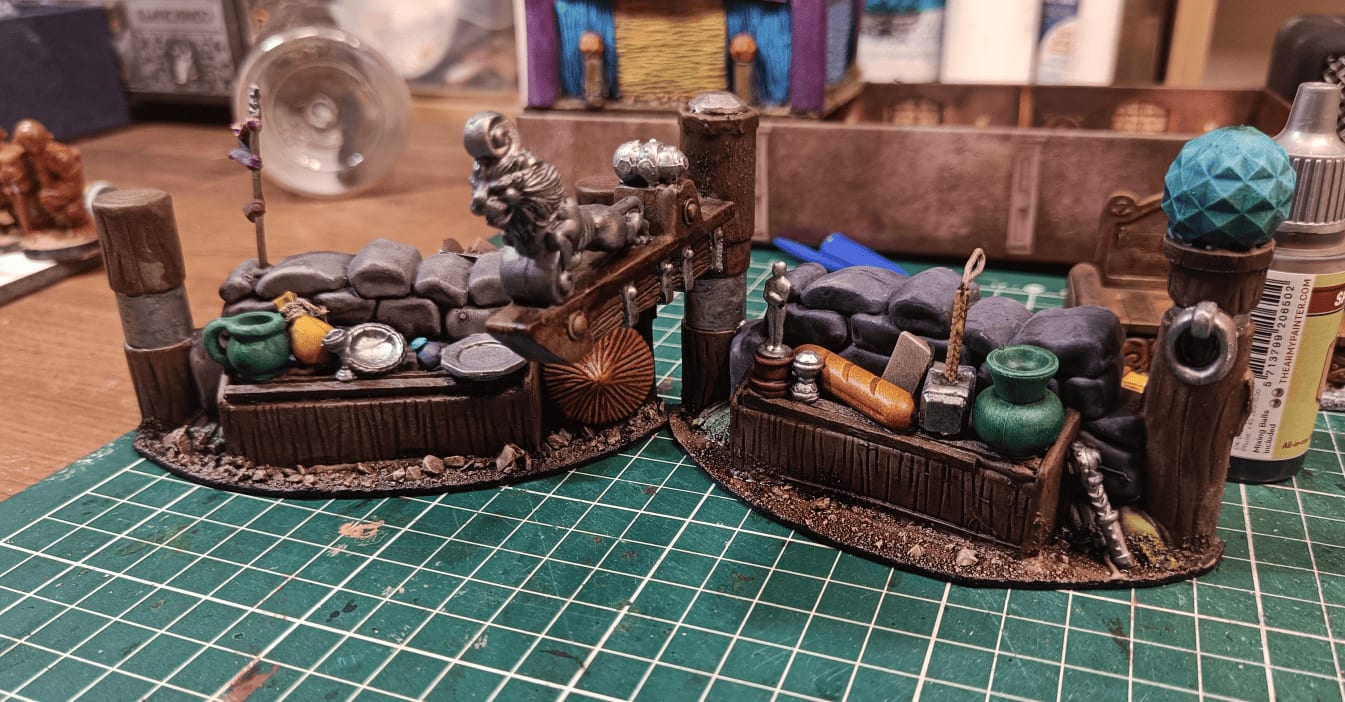
In the end, once all of this is done together, it looks pretty good.
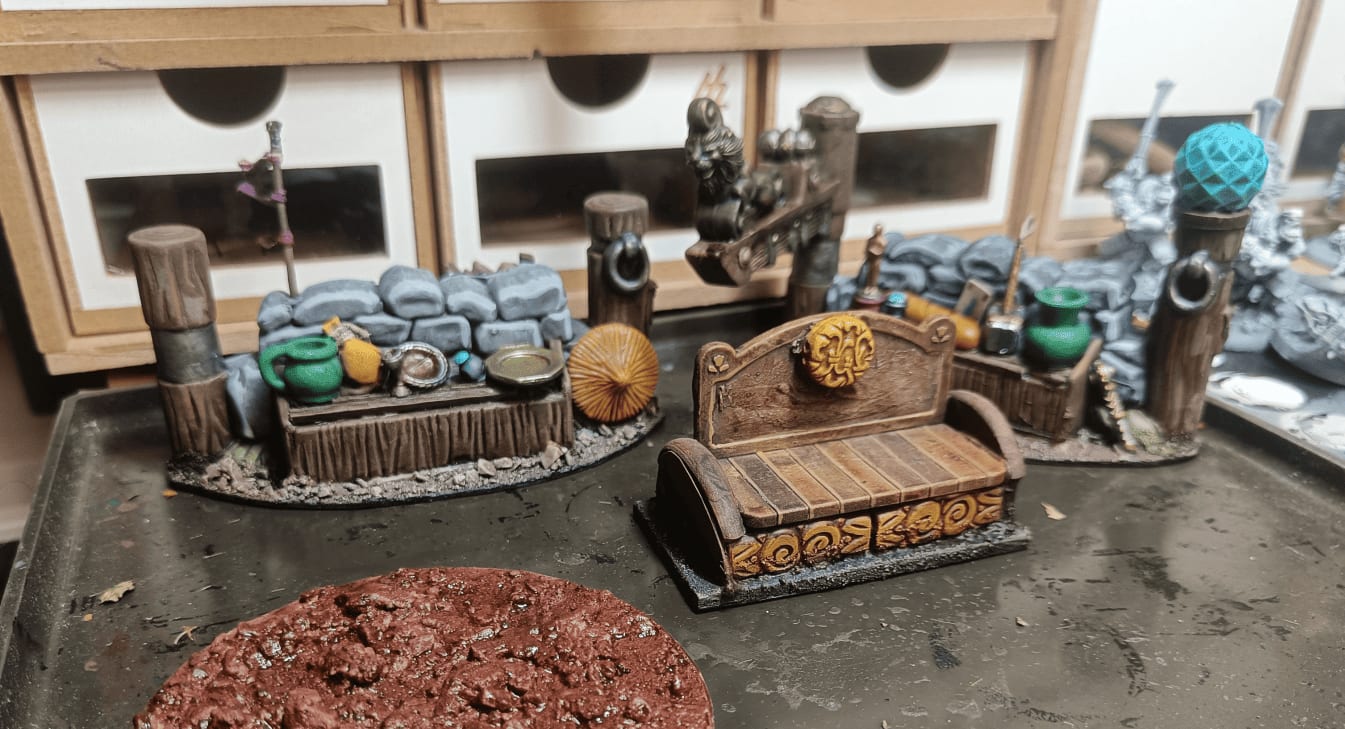
I even went a bit further and tested something I’d never done before, which is I did some highlighting. You can see it’s a bit rough on the bricks. I took a lighter gray to mark the edges a bit. It’s too visible, though. I did the same thing on the wood and there it’s less visible. So it looks really good. I took a light brown and just followed, slightly to the side, the lines of the wood’s edges. So everywhere there are scratches in the wood grain, I traced the edge of the scratch with a slightly lighter brown. Same on the bench itself. I added a bit of that and it’s subtle but it works really well.
This was my first time making this kind of scenery, so they’re not extraordinary. Some turned out better than others. I particularly like the walls with the odds and ends stalls and I like my wooden stands too. My tents do the job but they’re nothing special.