Bhaal Display Diorama
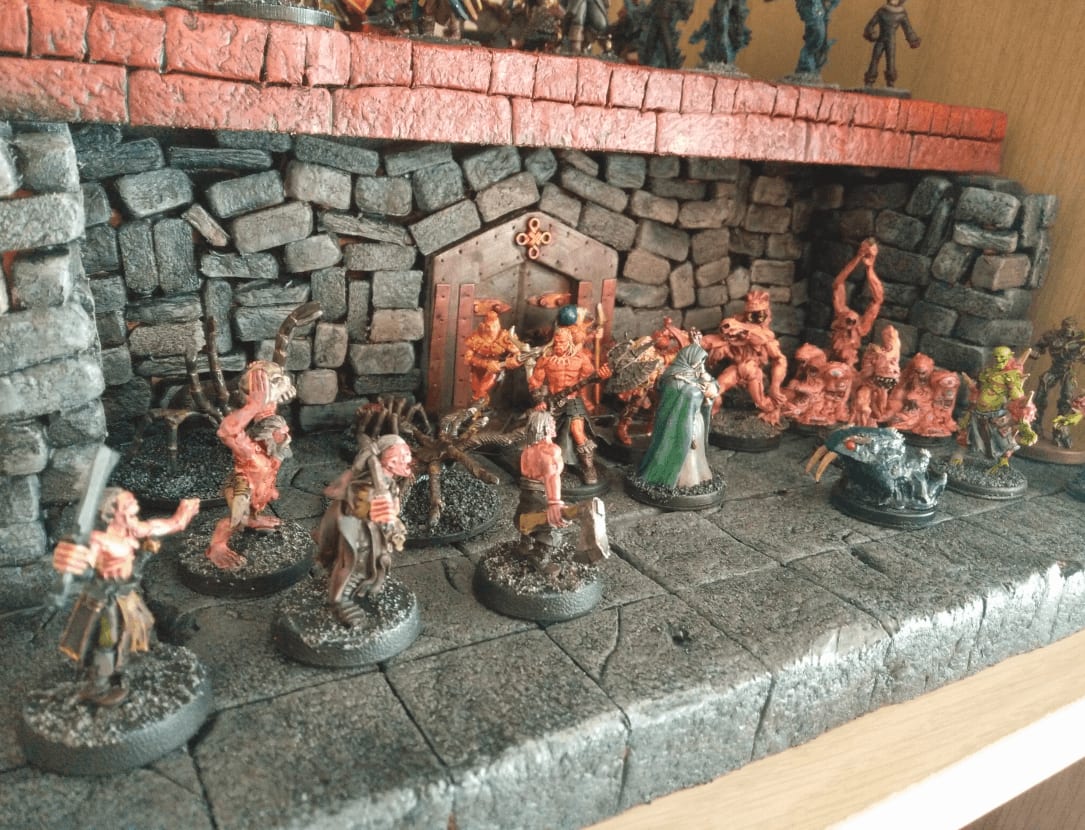


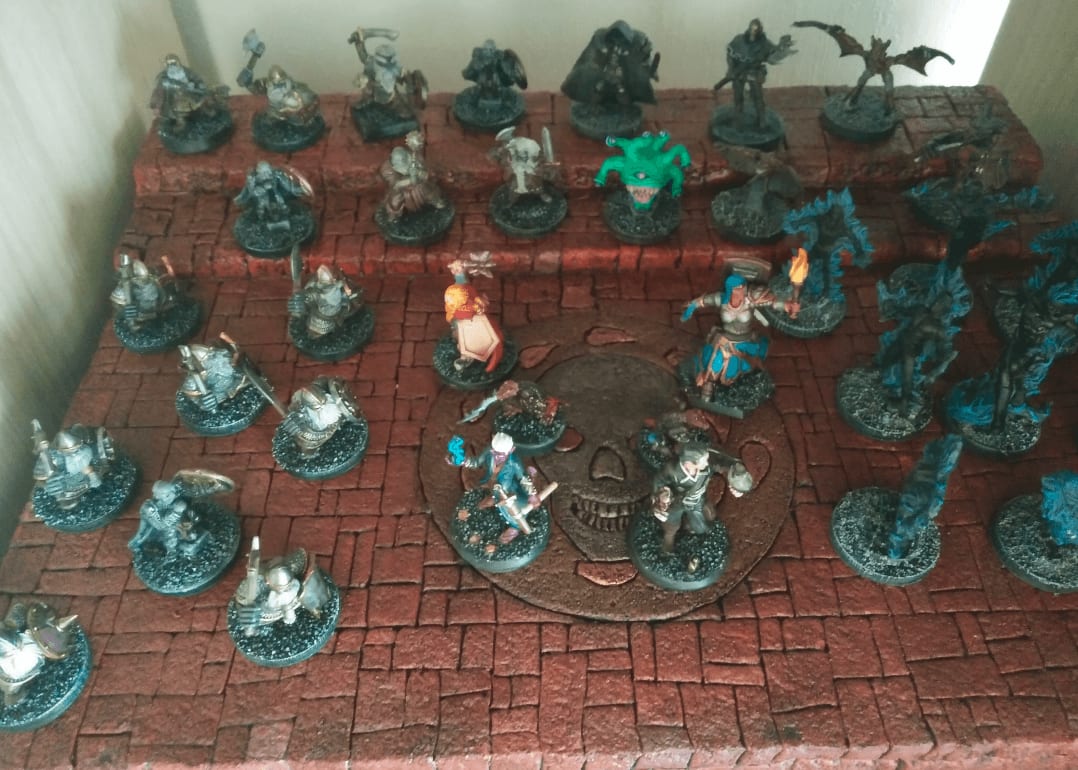
I'm starting to have a fair amount of painted minis for my games. I store them in plastic drawers but even if this storing method is practical, it is not very enjoyable. I like seeing my miniatures. I wanted to have a way to see them often, while still being able to quickly pick some for an upcoming game.
So I started working on a piece of terrain whose main purpose was to display miniatures. I intended to store this in one of the cubes of my IKEA Kallax, so I needed something that would take advantage of the 33cm x 33cm x 33cm of the cube. I had never worked with insulation foam before (but watched a lot of BlackMagicCraft videos).

I also wanted to build something that was reminiscent of the Temple of Bhaal, the room where you fight Sarevok, the final boss of Baldur's Gate. But because I needed to use as much vertical space as possible in my Kallax, I also needed some lower and upper levels. For the lower level I imagined some classic catacombs, and some elevated stairs for the upper level.
Turned out I completely miscalculated the space all of that would occupy and ended up with a construction much smaller in height that I imagined.
Timelapse

This is the final shape of the structure. The lower floor will be some stone tombs, and the upper one will be the Temple of Bhaal. Now I need to start carving this.

After some carving and minis for scale.
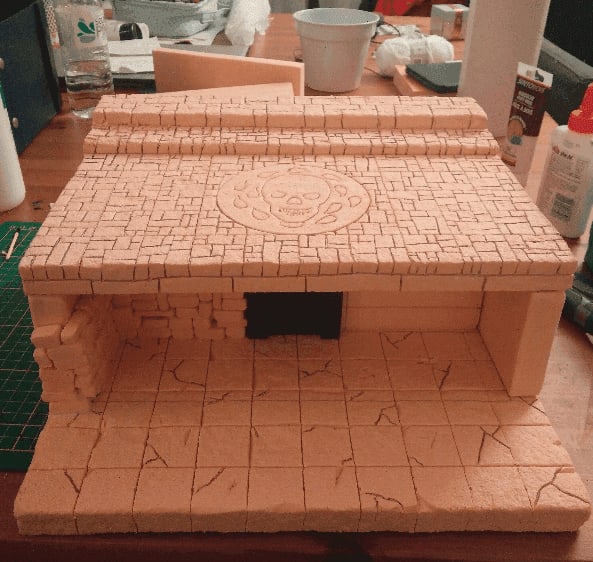
With the first bricks of the wall and the upper floor carved.
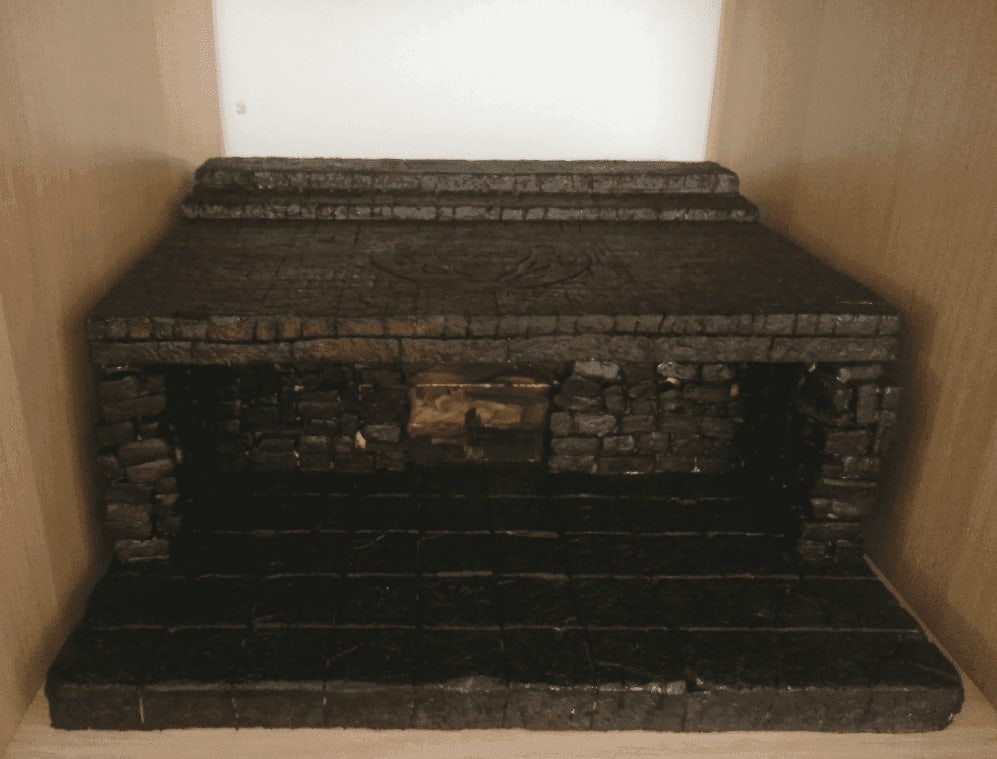
Everything is now coated, and painting will soon began.

Painting has started, but no wash has been applied yet.

This time it's finished, including the wash and the varnish.

The Dungeon

I started by cutting the foam in the desired dimensions. The main floor structure is 31cm x 31cm. I decided to keep 1cm on each side to better slide the piece in and out of the Kallax.
I also decided to have half the depth of the lower level "filled" and the other open. My idea that because I would add a first floor, it would be hard for me to access miniatures situated at the far end of the bottom floor, so I decided that actually didn't need the second half of the floor and decided to put a wall there. In hindsight I should have used the whole depth as the first floor is removable, it wouldn't have been too hard to access the minis at the far end.
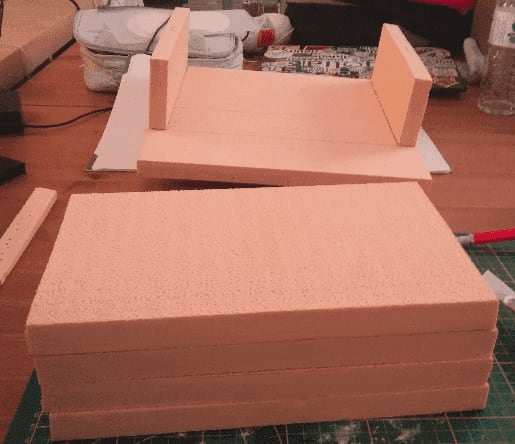
On the background is the lower floor, with its side walls. Foreground is 4 boards of foam glued together to "fill" the second half. Again, in hindsight this is a waste of foam and next time I will use the whole depth.

I started with the lower floor. Simple 3cm x 3cm square pattern. I use 3cm because it leave enough room for any 2.5 cm base to fit even when they have arms outstretched or weird poses. I then added some damage through holes or chunks of stone remove. I draw some cracks to went through them with an x-acto knife later.

I cut some bricks from foam to put on the walls of the lower floor. This was a long process because I sanded the edges and corners of each brick individually. In hindsight I should have sanded them before cutting them in small pieces. While I was nearing the end of the bricks I found a few ways to optimize my workflow, but it still took 2 to 3 hours to do enough bricks to cover my walls. I usually craft while listening to D&D live play podcasts, so I don't mind spending hours on it, though.

The brick wall a long process but I like the final look of it. In hindsight, I should have painted the wall black before gluing the bricks as it it now very hard to reach the wall between the bricks.

This is pretty clear in this picture. The wall behind the bricks shows too much.
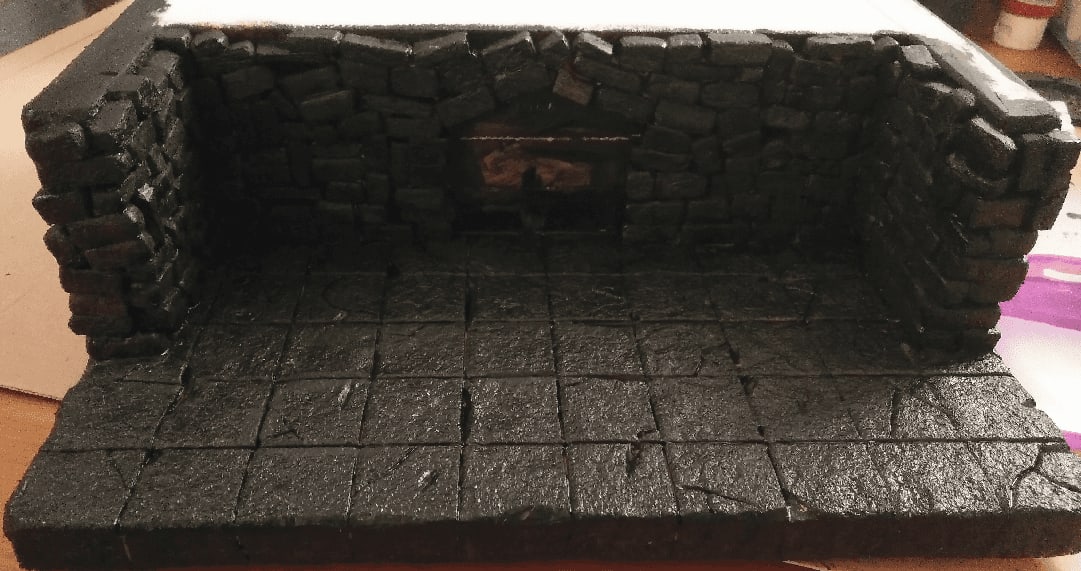
I used very diluted black paint and a small brush to try to cover as much of the back wall as possible. The end result looks ok, but it was a long process and next time I'll definitely paint the wall before attaching the bricks.

Base coat of grey. I was a bit too heavy on the central squares.

I painted a few bricks in various shades of gray.
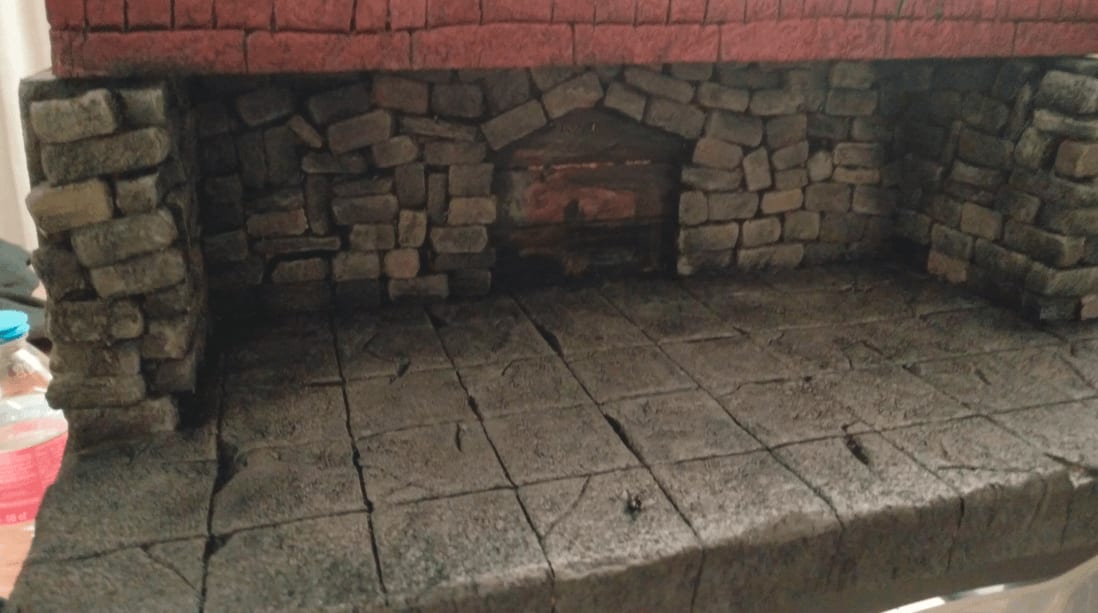
With the second dry brush of lighter gray and the wash on top.
The Temple of Bhaal
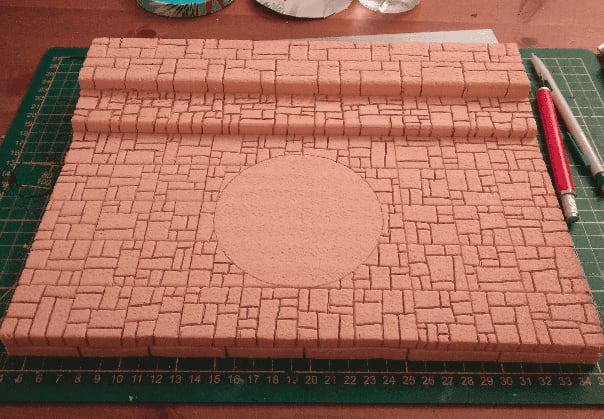
For the upper floor I started with the same grid pattern, then added some irregular smallest stones to it. I kept a circle clear at the center to carve the skull later.
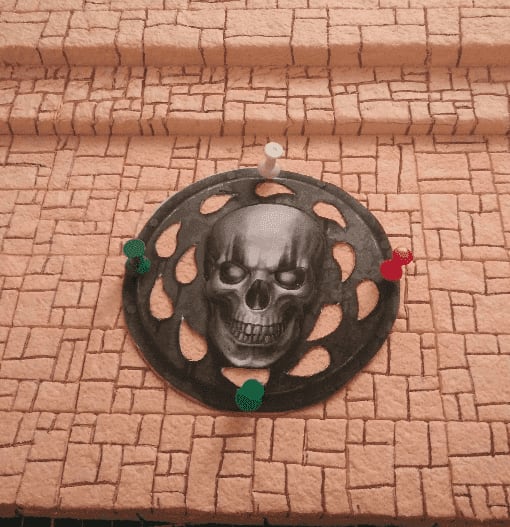
To carve the central skull I printed the Baldur's Gate logo on paper, cut it and then pinned it to the board. I then cut each tear around the skull with my x-acto knife through the paper, which marked the foam below it.

I did the same thing for the skull, and was left with a rough shape.

I pushed the small cuts with a pen to widen them. I wasn't 100% happy with the way the lowest tear turned out, nor the nose or eyes, but it was too late to fix them.

I then slapped a first coat of modge / black ink on the upper floor and started painting.

I painted the stone floor red and the skull orange.

I then painted a few bricks individually in similar colors, and painted with cheap metallic paints the skull.

I was afraid the contrast between the orange and the red would be too stark, so I decided to drybrush some red on the skull to blend the two together. This was a mistake and ended up looking very bad. I thought adding a black wash in the next step might fix this, so I didn't try to save it too much.
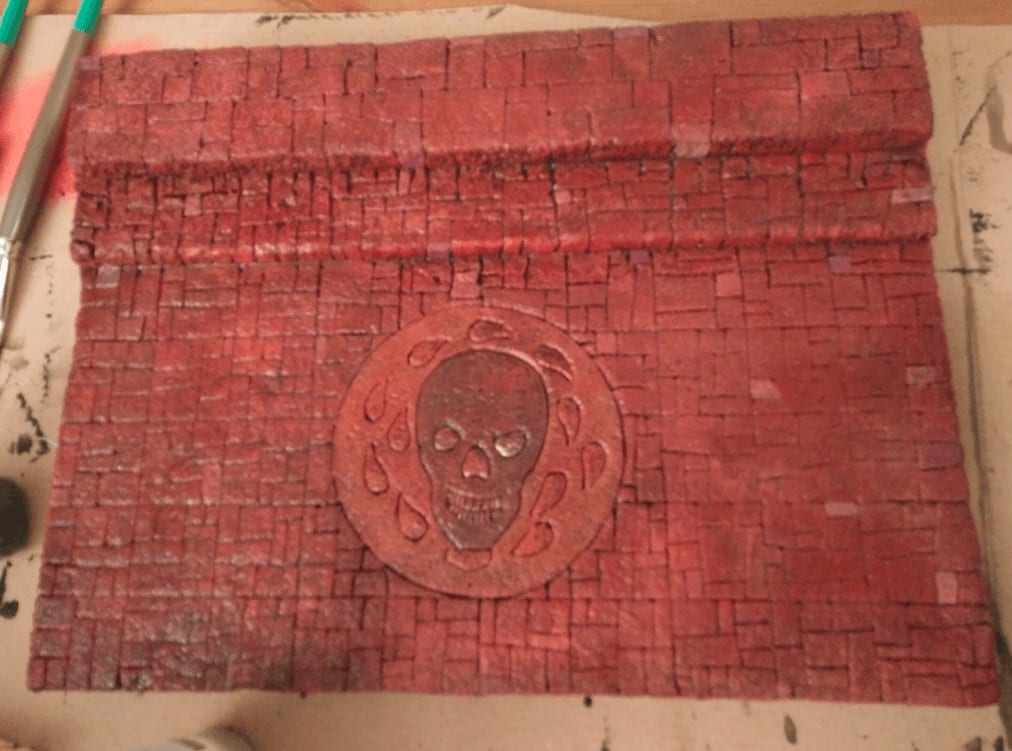
The wash was even worse... I don't know what happened with my wash, but it completely removed the copper paint I had on the tears as well as the paint on some of the bricks I had individually colored. I think it's because I'm using cheap craft paint and they seem to react weirdly with the wash. I need to wait for the paint to really dry overnight and not just 30mn to be able to apply the wash correctly.
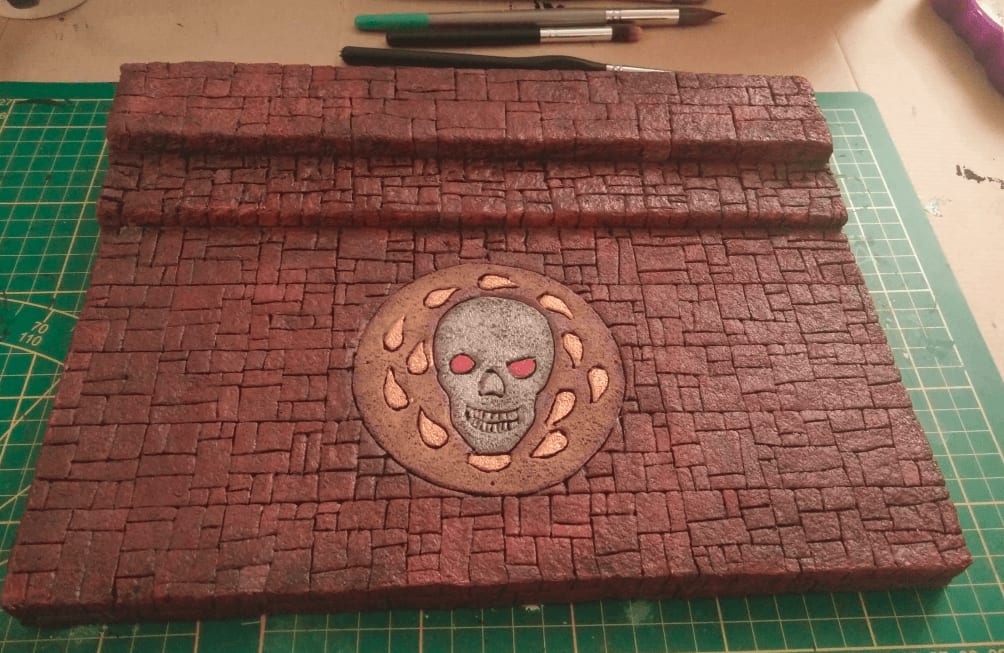
So I decided to repaint the skull on top of the wash. This time waiting 24h for it to dry. This time I decided to paint the eyes red.

Once I was sure it was really dry, I applied a liberal amount of wash to it and let it dry.